What is the state of AI adoption in DACH?
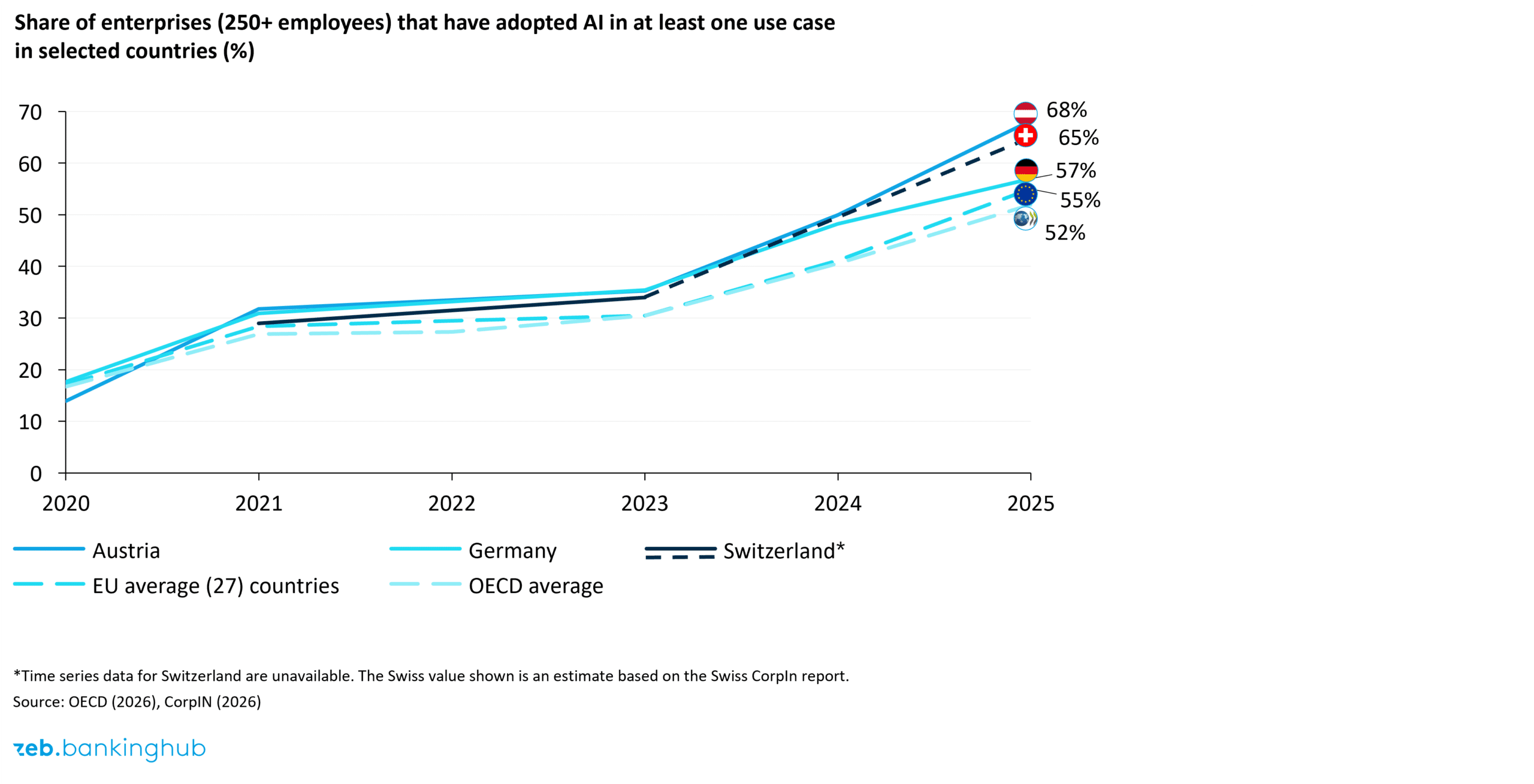
On paper, the DACH region has embraced AI. Across large enterprises, Austria (68%), Switzerland (65%) and Germany (57%) have all adopted AI in at least one use case. This adoption rate exceeds the EU (55%) and OECD (52%) averages, proving that AI has already become something of a baseline operational requirement in the region. Yet, when looking specifically into banking in DACH, we find a less convincing picture.
Adoption numbers tell us only half of the story. DACH enterprises show strong overall adoption rates, but at the same time the region falls behind on the things that make AI thrive: employee knowledge, skills and training. In addition, worry is the dominant emotion associated with AI across the DACH workforce, leaving the region with a lower trust and greater hesitation.
This matters because trust and capability, not technology alone, are what convert pilots into production. A bank can purchase an AI tool, but it cannot buy the organizational readiness to use it, making the readiness gap the first thing standing between DACH retail banks and the value they expect from AI.
Where is AI already delivering value?
Across the banks analyzed, established AI use cases cluster into four recurring, practically relevant archetypes:
- Conversational service and engagement. Multilingual chatbots and voice-enabled advisor tools in the front office. For example, Yuh, a Swiss neobank, handles around 4,000 chatbot conversations a week across four languages while cutting maintenance time by half.
- Risk, fraud and compliance intelligence. Real-time credit decisioning, fraud prevention and anti-money laundering (AML) monitoring in the middle office. N26, one of the best-known banks in the region, now scores every transaction in less than 500 milliseconds and has used AI to cut fraud volumes by around 80%.
- Identity and digital onboarding. Biometric verification and automated know-your-customer (KYC) checks automatizations have cut onboarding times from days to minutes – at TF Bank, processing time fell by 99.9% and conversion rose by 10%.
- Internal knowledge and workflow productivity. Document summarization, search and Copilot-style assistants. Prominent examples include Raiffeisen Bank International, which scaled an internal GenAI assistant to more than 20,000 users, and Deutsche Bank, which now runs more than 200 AI use cases in production.
A clear pattern emerges: AI delivers the most value where workflows are standardized, information-heavy and measurable, which is also why adoption is concentrated in the middle and back office. In the DACH retail front office, however, maturity remains limited. Only direct customer service has been scaled meaningfully through chatbots, while advisory services, sales, asset management and relationship management remain largely underdeveloped.
What is holding banks back?
Despite clear value creation in selected domains, our interviews highlight four recurring constraints that systematically limit broader AI adoption:
- Data foundation. Fragmented legacy architectures structurally limit AI adoption: critical data often remains siloed in core systems and even when accessible, inconsistencies, low data quality and missing standardization undermine reliable model deployment and scaling.
- Compliance and regulatory pressure. Regulation does not prevent AI adoption but materially increases governance complexity. Under the EU AI Act, obligations phase in, but the decisive enforcement milestone is August 2, 2026, when most rules, including those for high-risk systems, become applicable; full roll-out is reached by August 2,
- Organizational unreadiness and culture. Workforce enablement does not match leadership ambition: missing training, widespread skill gaps and underinvestment in human capital systematically limit adoption and value realization, even as AI spending rises.
- Cyber vulnerabilities. While typically manageable in today’s controlled, internal AI environments, they become a critical concern in customer-facing or automated use cases.
What separates the leaders from the laggards?
The interviews showed that one word captures the main difference between more and less AI-mature banks: centralization.
Banks that rate themselves as mature share a recognizable profile – a central AI unit, disciplined KPI tracking, well-curated data and investment in their own infrastructure. Those who rate themselves low describe the opposite: a top-down push to “have AI” with no clear business case, scattered development by employees on top of their normal duties and fragmented data.
Motivation also differs. More mature banks use AI for clear efficiency goals, such as reducing repetitive work and automating document-heavy processes. Less mature banks are often motivated more by competition – they follow AI trends primarily to avoid falling behind.
How can banks close the gap, and where does zeb step in?
Banks do not fail at AI because of a lack of ideas. They struggle because ambition, capabilities and execution are not aligned. The key is not to do everything at once, but to focus on what truly creates value today while systematically building the foundation for tomorrow.
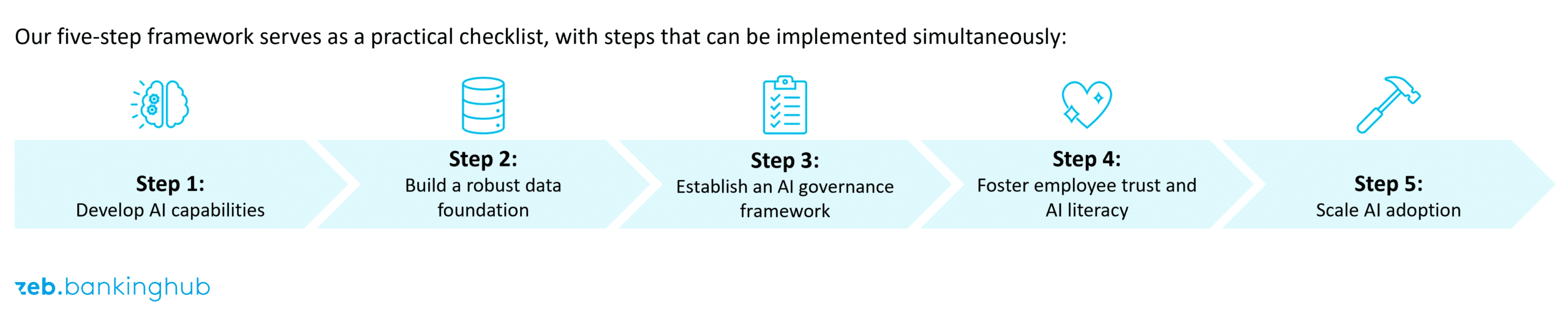
Based on our research, banks need to prepare five areas before scaling AI:
- Build AI capabilities end to end – across technology, data and workforce to enable delivery and scaling
- Establish a robust data foundation – integrating structured and unstructured data into a usable, well-curated base
- Set up clear AI governance – covering regulatory compliance, cybersecurity and strategic alignment
- Drive trust and adoption – through broad training, transparent usage rules and early employee involvement
- Scale use cases incrementally – guided by clear prioritization based on business impact, feasibility and risk
In practice, most banks already have initial use cases, but scaling fails because one or more of these dimensions are underdeveloped.
This is exactly where zeb makes the difference. We support financial institutions in turning fragmented initiatives into a coherent AI strategy and transformation by:
- Assessing AI readiness and defining a realistic ambition level
- Prioritizing use cases with clear business impact and regulatory feasibility
- Building the required data, governance and capability foundations
- Enabling end-to-end implementation, from pilot to scaled rollout
- Anchoring AI in the organization through training, change and operating models

AI strategy and transformation
 Please feel free to contact us
zeb helps banks move from isolated AI experiments to a scalable, value-driven AI setup, pragmatic where needed and ambitious where it creates real differentiation.
 Data Analytics and AI
We provide modern and ambitious financial services providers with holistic consulting on how to use data-driven technologies and support them in the resulting transformation process. Our focus is on applications from the areas of sales, customer interaction, processes, management and decision-making.