This image was generated using artificial intelligence (AI).

Why is proprietary real estate business facing growing regulatory scrutiny?

This image was generated using artificial intelligence (AI).
The prolonged low-interest rate phase prompted many banks to diversify their business models – often by investing in proprietary real estate business. What began as a supplement to traditional treasury operations evolved into a high-yield yet increasingly complex and risk-laden business segment at some institutions.

This article is structured according to the requirements set out in BTO 3 MaRisk. Each section addresses the established regulations and explores them in greater depth.
From profit driver to supervisory focus

The prolonged low-interest rate phase prompted many banks to diversify their business models – often by investing in proprietary real estate business. What began as a supplement to traditional treasury operations evolved into a high-yield, yet increasingly complex and risk-laden business segment at some institutions. Rising interest rates and new regulatory requirements have brought this area under closer supervisory scrutiny – posing fresh challenges for banks.

The changing conditions are affecting several levels. On the one hand, hidden valuation reserves are eroding due to rising capital market interest rates; on the other, ongoing project developments are facing pressure – both in terms of profitability and refinancing. At the same time, regulatory requirements are increasing, especially due to the explicit inclusion of proprietary real estate business in MaRisk (Minimum Requirements for Risk Management).

This article is structured according to the requirements set out in BTO 3 of MaRisk. Each section addresses the established regulations and explores them in greater depth.

Regulatory realignment: how is BTO 3 changing banks’ proprietary real estate business?

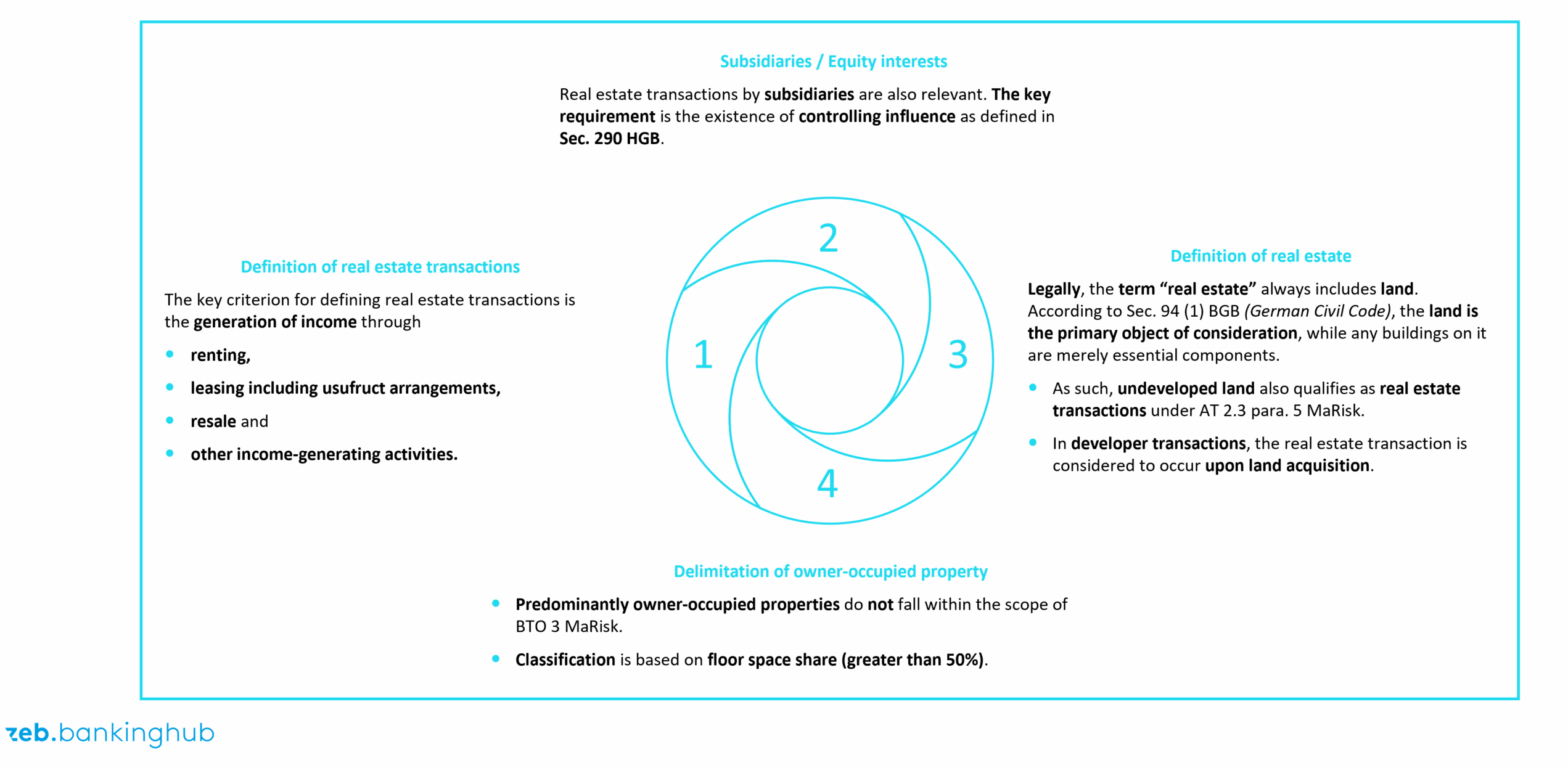
With the 7th MaRisk amendment, BaFin (German Federal Financial Supervisory Authority) has for the first time defined clear requirements for proprietary real estate business. The rules apply once the book value of real estate transactions exceeds EUR 30 million or the activities account for 2% of the total assets. Especially relevant: transactions by subsidiaries must also be considered – regardless of whether they are operational or purely asset-managing entities.

Properties used directly by the bank or those with mixed usage are not subject to these rules. Investments in real estate funds are also excluded. The regulations primarily target institutions that generate income from renting, leasing including selling properties – economically resembling a developer business.
Principles of BTO 3 transactionsFigure 1: Principles of BTO 3 transactions

Structures and governance: how to navigate between complexity and clarity

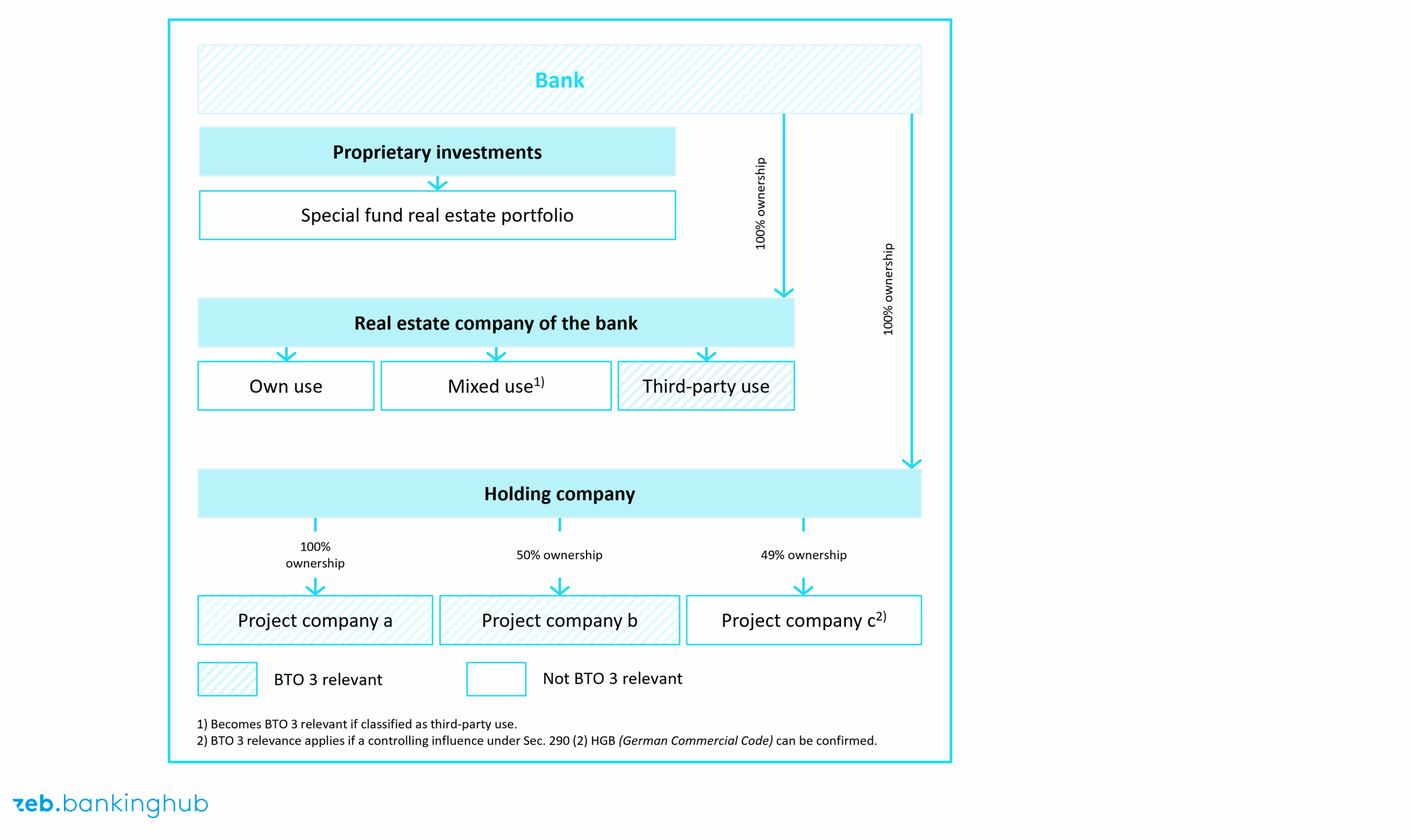
In practice, institutions often build proprietary real estate portfolios through subsidiaries. These structures are driven not only by tax and accounting considerations but also serve operational purposes – such as risk separation or integrating external partners. Ownership stakes range from majority to equal-share and minority holdings.
Proprietary real estate business: Exemplary structureFigure 2: Exemplary structure for proprietary real estate business

Regardless of the structure, the following applies: Dual approval by front office and independent risk function is mandatory – unlike traditional lending, where exceptions may apply under certain conditions. The front office role may be handled by the subsidiary, but the second vote must come from a back-office unit embedded within the bank.

Institutions that initiate all transactions through subsidiaries do not require a separate front office unit within the bank. Nevertheless, a quality review of third-party initiated transactions is necessary – not for substantive evaluation, but to ensure compliance with internal policies and regulatory requirements.

Clear authority rules must also be established for proprietary real estate business. These rules should primarily reflect investment volume but may be supplemented by factors such as project risk, location or partner structure. In cases of conflicting votes, an escalation process must be implemented – similar to lending procedures. Final decisions are often made by the investment management team or a responsible board member.

Processes and controls: professionalization required?!

Process requirements closely mirror those of commercial real estate transactions. Key elements include:

  • Construction progress monitoring: Institutions must conduct this regularly, document it and update it in a traceable manner. Using professional software tools to digitally track construction progress is recommended – not least to ensure audit compliance.
  • Valuation: Unlike in lending, where BelWertV (German Regulation on the Determination of Mortgage Lending Values) applies, proprietary real estate business follows ImmoWertV (German Real Estate Valuation Ordinance) Institutions typically engage external appraisers when projects fall outside their business area or internal resources are limited. Validating appraisal reports is mandatory.
  • Monitoring: Institutions must monitor their real estate holdings both on an ad hoc basis and at fixed annual intervals. Unlike in lending, no exemptions apply here – even for low-risk ratings or stable performance. Institutions are therefore expected to analyze their portfolios regularly and incorporate the findings into their annual reporting.

Reporting: how can greater transparency be established as a management tool?

Another key requirement is the annual report to executive management. The report must provide a cumulative overview of value changes and risks in the proprietary real estate portfolio. MaRisk does not prescribe a specific structure – giving institutions flexibility but also creating uncertainty.

Two approaches have become common in practice:

  1. Case-based reporting: this approach presents particularly high-risk or large-volume projects individually – including valuation, status and risk assessment.
  2. Cumulative reporting: this is done at the level of subsidiaries or project portfolios and enables a broader management perspective.

A combined approach is advisable: Individual risks are made visible without losing sight of the overall portfolio. Consistency with other reporting formats – such as the risk report or investment controlling – is essential.

Conclusion: how can regulatory resilience provide a competitive advantage?

Recent experience across institutions shows: Implementing the new requirements is labor-intensive – especially when aligning existing processes with the specifications of BTO 3. Institution-specific interpretations create uncertainty, particularly in defining relevant transactions or designing governance structures.

At the same time, the new regulation presents opportunities: Institutions that act early can not only minimize risks but also position themselves as regulatory-resilient – gaining credibility with both supervisors and the market. Establishing robust structures, clear responsibilities and digitally supported processes is essential.


5 practical tips for robust management of proprietary real estate business

  1. Conduct an early threshold analysis
    Regularly assess whether your real estate activities – including those of your subsidiaries – exceed the MaRisk thresholds (EUR 30 million book value or 2% of total assets). An internal early warning system helps identify regulatory risks at an early stage. Institutions considering distressed acquisitions should regularly analyze whether such takeovers affect threshold values during resolution. Ensure that the intended use is accurately recorded and clearly integrated into internal processes.
  2. Clearly define governance structures
    Establish clear roles, responsibilities and escalation paths – especially for dual approval by front and independent risk function. Use existing lending structures as a blueprint, but tailor them to the specific needs of proprietary real estate business.
  3. Use digital tools for construction and project monitoring
    Invest in professional software solutions for monitoring construction progress and documentation. This creates transparency, traceability and audit compliance – while also easing the burden on specialist departments.
  4. Standardize and document valuation processes
    Define clear criteria for selecting and validating external appraisals. Ensure consistent application of ImmoWertV and document any deviations in a traceable manner.
  5. Use reporting strategically
    Develop a standardized reporting format that maps individual risks and portfolio aspects. Use these reports not only to meet regulatory requirements but also as a management tool.

zeb supports banks in implementation – with proven best practices, templates, checklists and deep expertise in regulatory requirements for the lending and real estate business. This enables institutions to balance compliance and business development – even in the demanding environment of proprietary real estate transactions.

You should now be able to talk about these key points of the article:

What role does MaRisk play in the regulation of proprietary real estate business?

The 7th MaRisk amendment has for the first time set out clear requirements for proprietary real estate business. These rules apply once the book value of real estate transactions exceeds EUR 30 million or the activities account for 2% of the total assets. The same applies to subsidiaries’ transactions, regardless of whether they operate actively or are purely asset-managing institutions. This does not apply to properties that serve the bank’s immediate own needs or are used for mixed purposes as well as holdings in real estate funds.

What new challenges does BTO 3 pose for managing proprietary real estate business?

The regulatory realignment under BTO 3 is seen as a game changer. It leads to increased complexity and requires a more precise definition of structures and governance. Implementing the new requirements is resource-intensive – especially when aligning existing processes with the specifications laid down in BTO 3. Institutions must adapt their structures, define clear responsibilities and implement robust digital processes to minimize risks and ensure their regulatory resilience.


Feel free to contact us!

Christian Klaus / author BankingHub

Christian Klaus

Partner at zeb Office Münster
Niklas Rottmann / author BankingHub

Niklas Rottmann

Manager at zeb Office Frankfurt
Tom Meintrup / author BankingHub

Tom Meintrup

Senior Consultant at zeb Office Münster

The news you can look forward to on Mondays

Analyses, articles and interviews about trends & innovation in banking delivered right to your inbox every 2 weeks

Share article

Comments

Leave a Reply

Your email address will not be published. Required fields are marked *

BankingHub-Newsletter

Analyses, articles and interviews about trends & innovation in banking delivered right to your inbox every 2 weeks