Why is time a critical factor in the back office?
And to what extent is transparency becoming more important for efficiency, growth and competitiveness?
“Time is the scarcest resource – and the one success factor that cannot be increased.” (Peter F. Drucker)
The ability to use time wisely is crucial to an organization’s efficiency, responsiveness and future viability. In banking practice, this challenge is particularly evident in the back office: as a central function between market, risk and execution, it drives quality and speed – and thus growth and competitiveness.
Yet in many institutions, structural barriers remain prevalent: Extended processing and turnaround times in lending create friction with sales and reduce customer satisfaction. Missing transparency in process steps and coordination loops, inconsistent working methods and recurring queries between front and back office further slow down execution and increase the workload of the operational units.
Improving these processes effectively requires that inefficiencies are not only identified but also quantified objectively. The zeb.time gain analysis offers a structured approach that fulfills precisely this requirement.
What are the three strategic objectives of the time gain analysis?
The zeb.time gain analysis focuses on three strategic objectives:
- Creating transparency – by accurately capturing required time and visualizing process variations and coordination cycles
- Uncovering bottlenecks – by systematically uncovering the root causes of time loss
- Promoting uniformity – by implementing standardized and consistent procedures
Sustainable optimization requires a sound diagnosis of actual workflows and empowers a back office to redefine its role: from a purely administrative function to an active driver of efficiency, quality and future readiness.
How does data collection help create transparency around actual time allocation?
And how does it help make process barriers visible?
As previously outlined, creating transparency is a key lever for increasing efficiency and quality in the back office. This, however, demands a solid foundation that transcends mere subjective perceptions. Even though inefficiencies and time drains are often noticed in daily operations, clear data to substantiate and address them structurally is frequently missing.
A pragmatic solution to this challenge is the zeb.time gain analysis: a streamlined, privacy-compliant survey enables the objective and anonymous identification of specific processing barriers and so-called “time sinks”. At its core is a web-based activity log that allows employees to effortlessly document their work using standardized categories. The survey may be conducted in real time or retrospectively and records the amount of time spent on each process step, whether or not it adds value, involves loops, waiting times or unnecessary complexity.
A key methodological principle applies: The survey is open-ended and explicitly non-performance-based. The goal is to generate structural transparency regarding actual time usage, not to assess individual performance. This involves a nuanced analysis of role profiles: for back-office employees, activities are categorized as either value-adding or non-value-adding, while for managers, tasks are distinguished between leadership responsibilities and operational support (see Figure 1).
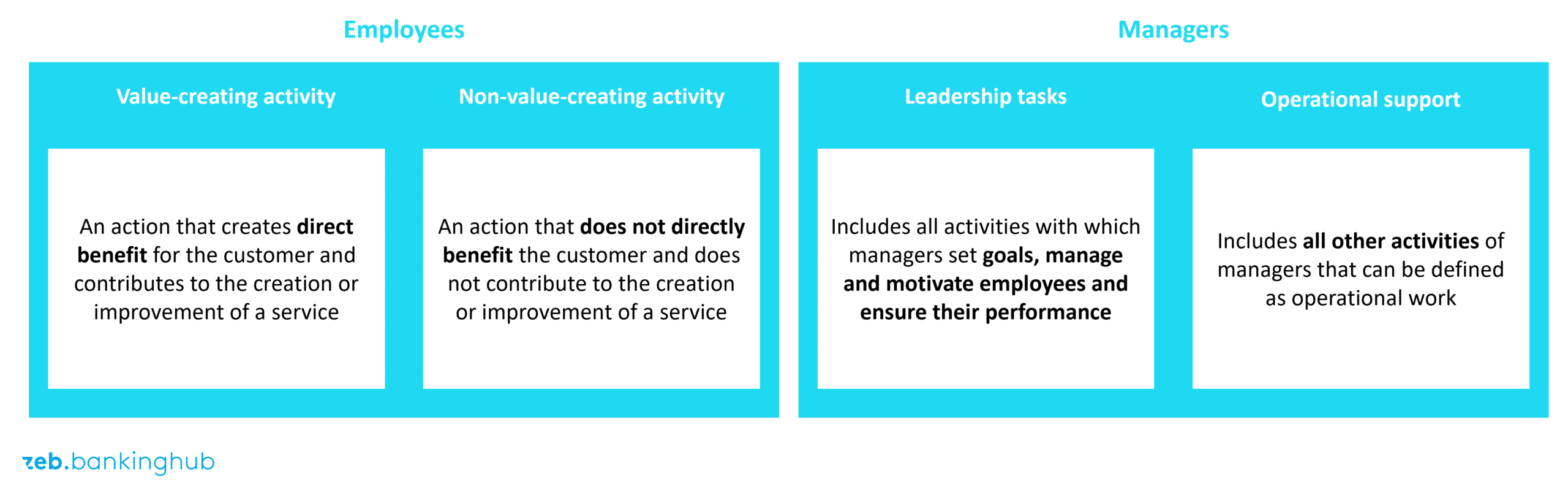
Full data anonymization, GDPR-compliant storage and the exclusive evaluation at group level (minimum of three employees) ensure that no conclusions can be drawn about individuals.
Figure 2 illustrates what a sample evaluation based on real data can look like. The heat map shows how time is distributed across activity fields and highlights significant differences between groups. It clearly reveals how non-value-adding tasks – such as portfolio or application processing – vary widely, offering concrete starting points for optimization.
This objective and secure method of data collection provides a reliable foundation for analysis – beyond subjective perceptions. It enables the visualization of time usage, the measurement of internal coordination efforts and the identification of differences in working methods. This lays the groundwork for informed discussions about improvements – fact-based, solution-oriented and widely accepted by the groups involved.
What are the four overarching action areas for efficiency potential following a successful analysis?
Practical insights
Based on experience to date with the zeb.time gain analysis, overarching action areas can be identified in which efficiency potential in the back office regularly emerges. These regularly include the following:
I) Further development of credit processes
A recurring observation involves comparing internal credit processes with industry association guidelines. Clear opportunities for improvement are often left untapped. In addition, it is clear that collaboration between front and back office is frequently hindered by redundant inquiries and unclear processes – closer, standardized coordination could significantly speed up processing. Existing systems and workflows are often not reviewed regularly, leaving manual tasks in place and automation potential untapped.
II) Streamlining internal processes
Interfaces often suffer from media discontinuities and redundant steps, typically due to inconsistent tools or unclear responsibilities. Coordination rounds often take longer than needed due to non-standardized information flows or vague role definitions. Automated workflows are often missing or inconsistently applied, limiting operational efficiency and straining resources.
III) Risk management and compliance
The control environment also offers structural opportunities for improvement. Time-consuming control steps that have not been consistently replaced by standardized workflows lead to avoidable additional effort. In addition, unclear responsibility assignments slow down processing and increase coordination needs. Several institutions found that there is a lack of standardized reporting systems in risk management, which means that critical deviations are only recognized with a delay.
IV) Personnel and skills development
Efficiency and quality in processing also rely on clearly defined leadership structures. In many cases, however, managers fail to prioritize between process oversight, quality assurance and staff development. Administrative duties limit the capacity for coaching, team building and strategic leadership. In addition, targeted training and structured feedback on employee development often does not take place systematically.
How does the time gain analysis help enable sustainable optimization?
And why is transparency a crucial foundation for effective transformation?
Transforming the back office into an active contributor to credit processes requires more than isolated initiatives – it demands a deep understanding of real-world workflows. This is precisely where the zeb.time gain analysis plays a pivotal role: It provides reliable transparency into time allocation (value-adding vs. non-value-adding tasks) and organizational inefficiencies.
By combining streamlined, anonymized data collection with group-level analysis, it enables objective discussions about efficiency barriers – free from personal judgment or blame. Instead, the emphasis shifts to structural improvement: Where workflows differ, coordination consumes time or manual routines drain resources, targeted improvements can be introduced.
The analysis offers both a solid foundation for managerial decisions and a catalyst for organization-wide dialogue on standardized, future-ready workflows. Because lasting transformation doesn’t start with the next technology – but with a clear understanding of current realities.