Communication as the key success factor for mergers – not a sideshow!
A bank merger takes a lot more than simply merging two balance sheets. It requires a profound organizational and cultural change. This is precisely where communication is either the key to successful transformation – or becomes a blind spot in the project.
Three typical real-life pitfalls for merger projects:
- Stakeholders do not receive the information they need. Employees feel ignored, customers are perturbed. The office grapevine replaces official communication.
- Initial communication is often underrated. Without a tangible vision, committees fail, and a lack of expectation management leads to the loss of important support. Cultural differences are not actively addressed. Instead, tribal mentality and subliminal conflicts (“us versus them”) arise, which can impede the integration process.
- Communication by managers is unclear or incomplete. Managers do not clearly communicate the reasons for the change or leave out important core messages.
Our recommendation: Communication is a strategic management tool as well as a leadership task. Those who do not actively anchor the responsibility for communication at board level are jeopardizing the trust, speediness and ultimately the success of the entire merger.
Communication not only determines what is understood, but also whether change is accepted and supported. The deciding success factors for mergers are:
- Clarity: Why are we merging? What is going to change? What will stay the same?
- Stringency: consistent communication across all channels and hierarchy levels.
- Dialog: communication begins with listening – not with sending.
Reality shows that many banks communicate late or in an uncoordinated manner or underestimate the emotional dynamics of change. It’s the first 100 days after the announcement in particular that shape the perception of the entire process – among employees, customers and involved committees.
Communication and trust as the foundation of successful mergers
Trust is the biggest lever in any merger and determines whether employees support it – or block it. In zeb’s experience, one thing is clear:
“Change follows the rhythm of communication.”
Where information is lacking, uncertainties grow. Organizations lose focus, speed and often also (political) support.
Our experience has shown: decisions must be made swiftly and transparently. Every week of uncertainty costs acceptance and speed.
What used to be sufficient is no longer enough: communication in 2025
Simple mass e-mails or grapevine communication no longer work. Employees and customers expect:
- Genuine participation instead of one-way communication
- Formats with a personal touch: video messages, town halls, intranet updates
- Storytelling instead of endless columns of numbers
Today’s communication is more digital, more dialogic and more measurable. Social media, newsletters and Q&A formats create closeness and commitment – even (and especially) in uncertain times. At the same time, they influence the emotional dynamics and thus the acceptance and speed of a change process.
Our zeb communication model: communication as a success factor
Communication is not a risk – it’s the greatest opportunity in merger processes
At zeb, we see communication not as a challenge, but as a strategic success factor. Properly designed, it enables all stakeholders – employees, customers, committees and the public – to be informed throughout the merger process, building trust and generating positive emotions.
This perspective has also proved itself in practice: merger communication is no longer a sideshow. It is a fixed element of every successful merger and is increasingly being actively requested and considered by our clients in the regional banking sector.
Our zeb communication model: four steps to success
The zeb communication model comes into play at an early stage and is woven into the entire merger process. It is developed in collaboration with employees of the merging banks. We always take regional, cultural, political and historical particularities into account – and adapt the communication concept according to how the project is evolving and what feedback we receive from the various stakeholders.
Four key points form the basis:
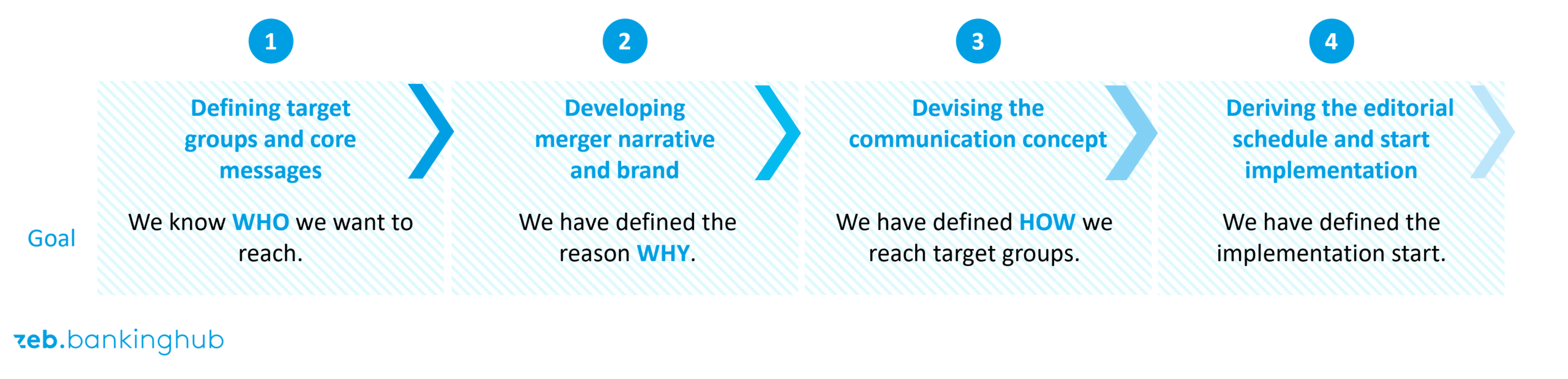
1) Who are we targeting? – Define target groups
- Jointly identify the relevant target groups
- Analyze the needs and expectations of the identified target groups
- Create an early consensus on value propositions and core messages
2) Why do we do it? – Create a merger narrative
- Develop a powerful and authentic change story that emotionally resonates with employees and customers
- Create an identity-establishing narrative with a clear vision (e.g. through slogans such as “ZusammenWachsen” (“GrowingTogether”))
- Utilize storytelling as a link between the various communication channels
3) How do we reach them? – Shape the communication concept together
- Select suitable formats and channels (intranet, podcasts, town halls, social media)
- Develop an action plan
- Define measurable KPIs for continuous steering and monitoring of success
4) When do we start? – Devise and implement an editorial plan
- Create an editorial plan with clear tasks, responsibilities and milestones
- Continually monitor success regarding the KPIs
- Adapt freely during the ongoing process
What could target group-specific communication look like in practice? See for yourself!