How well prepared are regional banks for the EU Pay Transparency Directive?
What was previously considered low risk is becoming a significant governance, cost and liability issue under the EU Pay Transparency Directive. Regional banks in particular face the challenge of critically reviewing their existing structures, making decisions that have evolved over time transparent, and safeguarding objective criteria across the entire remuneration system.
The new EU Pay Transparency Directive (EU) 2023/970, introduced on 7 June 2026, sets out three key requirements.
1) Does the institution maintain up-to-date and consistent job descriptions across all roles?
Job descriptions are the indispensable basis for job classification and job evaluation and, in turn, for forming comparison groups.
2) Does the institution correctly apply the collective agreement’s classification logic, and does it have a documented job evaluation methodology for non-collectively agreed positions?
Comparison groups are only robust when they are based on objective classification criteria. The only determining factor is the requirements of the role, not individual salary expectations.
3) Are all remuneration instruments documented and used on the basis of objective criteria?
In addition to collectively agreed remuneration instruments, non-collectively agreed compensation components are also regularly granted. It is crucial to ensure that these components are used in a manner that complies with all applicable regulations and relies on transparent, objective criteria.
If these questions cannot be answered adequately today, the consequence is significant financial and regulatory risks. If differences in pay for comparable roles cannot be justified by objective criteria, mandatory upward salary adjustments may be required, which, according to initial estimates, could lead to structural increases in personnel costs of up to 15%.
At the same time, compliance risks arise from potential fines, retroactive salary back payments and claims for damages with no statutory cap. Since remuneration systems already form part of banking supervisory reviews today, the absence of a systematic approach may be considered a governance or organizational deficiency in the context of BaFin, ECB or statutory audits.
Why should regional banks fundamentally review their remuneration systems right now?
Remuneration has long been stable terrain for regional banks. Collective agreements with a summary classification logic provide an orderly framework. However, this seemingly solid foundation is beginning to crack. Recent rulings by the German Federal Labor Court, coupled with the impending implementation of the EU Pay Transparency Directive 2023/970, will make remuneration one of the most relevant governance and liability issues from June 7, 2026, at the latest.
In short, regional banks that fail to act now risk triggering an upward pay spiral. If a comparison reveals a pay difference that cannot be objectively justified, it gives rise to an adjustment claim that is generally based on the higher reference salary.
Pay Transparency Directive: from an equality issue to a management and P&L risk
Pay transparency legislation aims to ensure equal pay for equal work or work of equal value, irrespective of gender.
Definition: According to Article 4(4) of the EU Pay Transparency Directive 2023/970, work of equal value means that different roles have a comparable level of requirements. These roles do not have to be identical, but they must involve a comparable level of professional requirements. Work of equal value is assessed on the basis of four criteria:
- skills,
- effort,
- responsibility and
- working conditions.
Example: An advisor in private banking and one in corporate banking may perform work of equal value if the scope of responsibility, qualification requirements and decision-making authority are comparable.
Germany has had a pay transparency law in place since 2017. At present, however, disclosure rights only apply to workforces exceeding 200 staff members. These rights require sufficiently large comparison groups and refer only to median values. In addition, companies are only required to respond when workers actively request information.
That is precisely what will change by June 2026 at the latest. The EU Pay Transparency Directive (EU) 2023/970 shifts the focus away from isolated disclosures and toward systematic transparency. This includes, among other things, expanded disclosure rights for workers, reporting obligations for companies and greater clarity on remuneration as early as the application stage.
The European legislator is addressing two core problems:
- Lack of transparency in remuneration systems
- High barriers for workers seeking to prove discrimination
The judgment of the German Federal Labor Court: pairwise comparison instead of system logic
A recent judgment by the German Federal Labor Court shows that case law is already aligned with the European requirements. In its October 23, 2025, judgment (Case No. 8 AZR 300/24), the Federal Labor Court clarified the standard that applies to the presumption of remuneration discrimination. The core message is clear: a one-to‑one comparison is sufficient.
The case centered on a claim brought by a female middle manager who argued that a male colleague was receiving higher pay for the same or equivalent work and sought an adjustment to her salary. Among other arguments, the employer contended that the roles were not fully comparable and pointed out that the claimant earned less than other female colleagues, which, in the employer’s view, argued against gender-based discrimination.
However, the German Federal Labor Court held that such reliance on average or median values is legally impermissible. According to the court, a pairwise comparison is sufficient to trigger the presumption of gender-based pay discrimination, meaning that the employer must provide objective, gender-neutral reasons for any difference in pay.
Why are collective agreements alone not enough?
Collective agreements are generally based on objective criteria. From zeb’s perspective, however, the collective-agreement framework alone does not protect against risks arising from the Pay Transparency Directive.
In practice, risks are particularly evident where remuneration decisions have historically been made on a case-by-case basis.
Critical scenarios include:
- Personal complementary pay components or non-collectively agreed salary components granted for employee retention without a transparent underlying system
- Continued remuneration for managers who, as part of mergers or reorganizations, have lost their management responsibilities
- Different starting salaries for the same role resulting from individual negotiations or tight labor markets
- Salary developments or reclassifications that have accumulated over many years without a corresponding change in the role
- Job changes of workers whose salary remains unchanged regardless of the pay evaluation assigned to the respective position
Such historically evolved differences were often regarded as unproblematic as long as remuneration systems as a whole were considered to be governed by collective agreements. That is now changing. These historical pay decisions can result in two workers performing the same or equivalent work while being paid and/or classified differently.
If this then leads to a request for information or a lawsuit, referring to the collective-agreement classification alone does not suffice. In a pairwise comparison, the decisive question is: why does the male colleague earn more for the same or equivalent work? If the bank cannot provide objectively documented reasons for the higher pay level or the complementary pay component, a presumption of pay discrimination arises, even if the collective agreement is formally complied with.
The consequence is an upward adjustment of remuneration to the highest pay level.
What does the Pay Transparency Directive actually require?
The combination of the new legislation and current case law gives rise to several fields of action for regional banks.
Going forward, remuneration systems must not only be formally sound but also be objectively transparent and justified by clear criteria in each individual case. In addition to a systematic review of the remuneration actually paid – including base salaries, complementary and variable pay components and non-collectively agreed salaries – the fields of action listed below are essential.
1) Up-to-date and consistent job descriptions covering the following aspects
- Tasks and job content
- Scope of responsibility and decision-making authority
- Required qualifications and experience
- Organizational classification
- Specific demands or working conditions
- Information on all facts relevant to classification
Every position must be described in a transparent and comprehensive way. The aim is a rule-based job classification or job evaluation that allows roles to be compared as a basis for determining equal work or work of equal value.
2) An objective, transparent job evaluation system
- Consistent classification of collectively agreed positions in accordance with the provisions of the collective agreement
- Neutral and transparent evaluation of non-collectively agreed positions using a summary or analytical evaluation method
3) Clearly defined and documented remuneration structures for
- Assignment to collectively agreed or non-collectively agreed pay groups
- Assignment to development stages or years in the role
- Granting of complementary pay components
- Variable remuneration
4) Fulfillment of reporting obligations
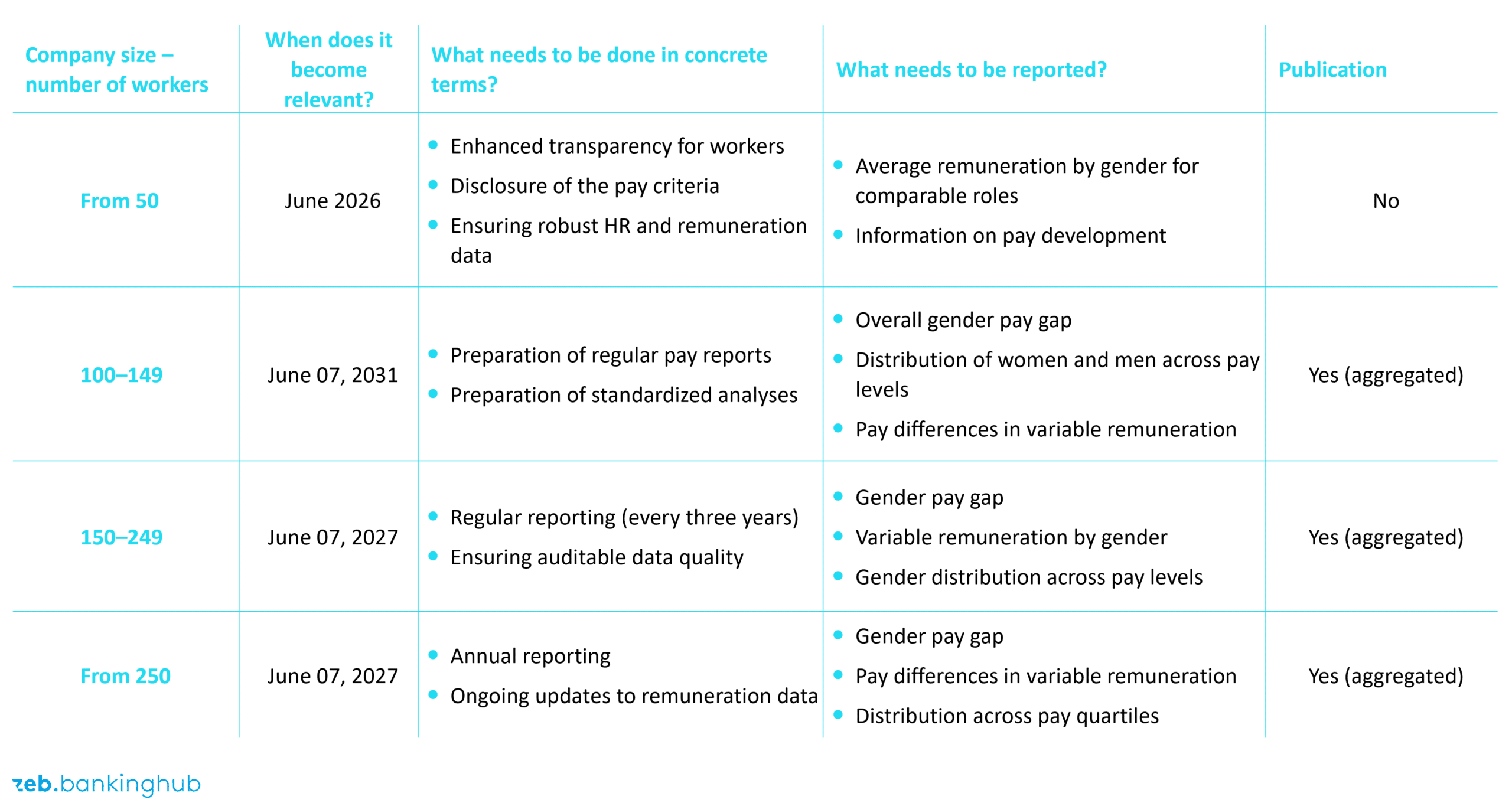
In addition, if a gender pay gap of more than 5% is identified, a joint pay assessment must be carried out jointly with workers’ representatives, and specific corrective measures must be derived and implemented. The causes identified and the resulting measures must be reported to the workers’ representatives, company management and, where applicable, to internal audit and compliance.
The Pay Transparency Directive is not a niche issue; it affects organizations of every size.
Race to the top: to what extent can pay transparency become a cost and management risk?
The requirements described can trigger a dynamic that increases personnel costs and may be accompanied by cost and reputational risks that threaten an institution’s viability:
- Only upward salary adjustments are permitted: If a pay difference cannot be justified through a pairwise comparison, this gives rise to a claim to adjust the lower salary to the higher comparator salary.
- Back payments – including social security contributions: In addition to any necessary salary adjustments, back payments may be due retroactively, including social security contributions and payroll taxes. Depending on how long the unequal treatment has persisted, these payments can result in substantial additional financial burdens.
- Chain effects from new reference salaries: Once a salary is raised, it can itself become the new reference point for further pairwise comparisons within the comparison group. Without consistent classification and job evaluation, this creates a self-reinforcing dynamic in which remuneration gradually moves toward the upper end of the pay structure.
- Increased litigation and disclosure risks: Expanded disclosure rights make it more likely that workers will question differences in pay. Historically evolved special arrangements or inconsistent groupings cannot be effectively defended in such proceedings.
- Reputational risks: Published gender pay gap metrics are attracting increasing attention. Large pay disparities can undermine trust, damage the employer brand and turn remuneration into a reputational issue.
- Loss of management control: This ultimately creates a strategic risk. If remuneration decisions have to be implemented in an uncoordinated manner and primarily through case-by-case corrections, organizations lose the ability to manage remuneration strategically. This increases fixed costs without any real room for maneuver.
In the absence of a clear evaluation logic or consistent pay structures, an economic dynamic emerges where individual adjustments set new reference points and may trigger further adjustments.
From risk to management: how does a phased approach work for regional banks?
The risks described make one thing clear: ‘wait and see’ is not an option. The task now is to gradually transition toward an actively managed, compliant structure.
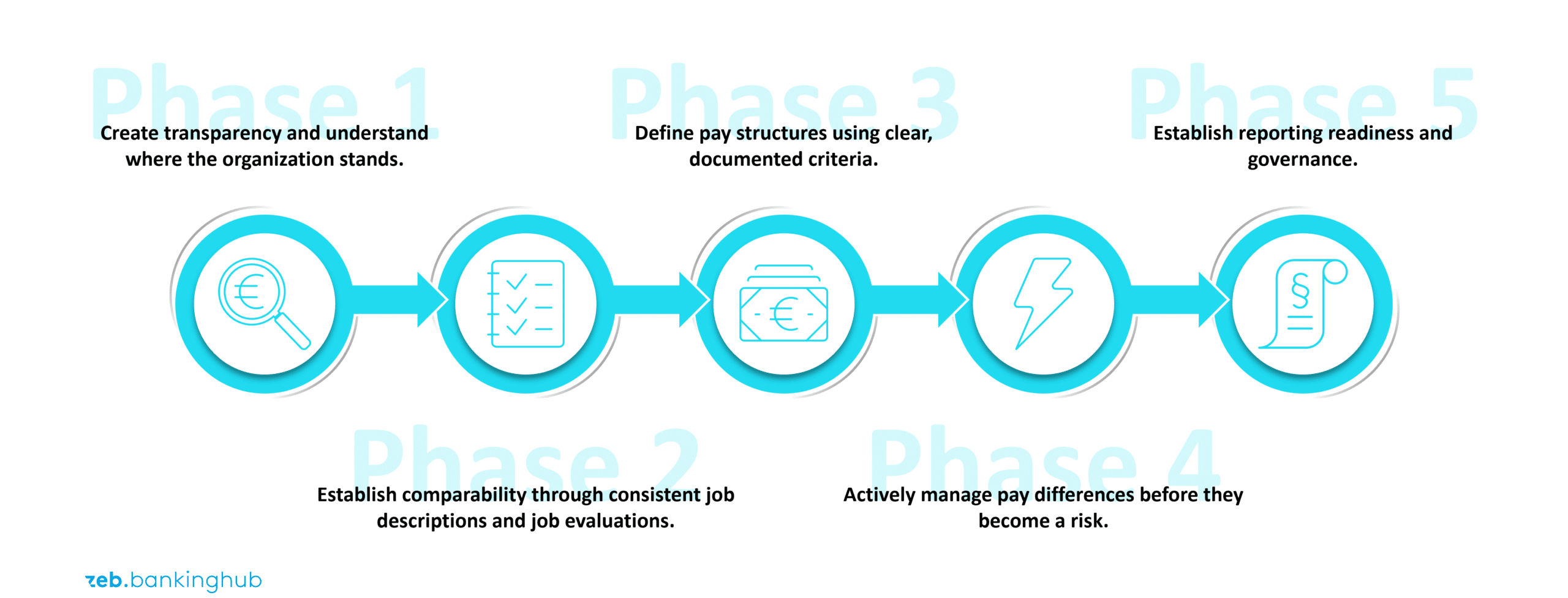
Phase 1: Create transparency and understand where the organization stands.
Regional banks should gain an overview of their existing remuneration systems and the instruments they use. This includes analyzing the remuneration actually paid, covering all collectively agreed and non‑collectively agreed components. The next step is to identify any notable differences in pay between comparable roles.
Phase 2: Establish comparability through consistent job descriptions and job evaluations.
A key prerequisite for comparability is having consistent job descriptions that clearly outline tasks, responsibilities, qualification requirements and organizational classification. Additionally, positions should be systematically evaluated so that equal work and work of equal value can be grouped into comparison categories.
Phase 3: Define pay structures using clear, documented criteria.
Institutions should clearly define how each position is remunerated. For positions covered by collective agreements, the pay scales set out in those agreements provide a solid basis. For non-collectively agreed roles, institutions must establish dedicated pay structures. It should be noted that non-collectively agreed pay is subject to co-determination.
Phase 4: Actively manage pay differences before they become a risk.
All pay differences must be justified and documented. If pay differences cannot be explained by objective, transparent criteria, they must be corrected. The appropriate action for each case should be decided in the context of an overall assessment.
Phase 5: Establish reporting readiness and governance.
Finally, pay transparency must be embedded within the organization. This includes establishing clear responsibilities, maintaining clean HR and remuneration data and implementing processes for meeting disclosure and reporting obligations.
In practice, these steps are rarely completed as a one-time project. Rather, pay transparency is evolving into an ongoing HR management and governance task.
What overall conclusion can be drawn from the forthcoming legislation?
Pay transparency is fundamentally changing the rules that govern remuneration. Due to new legislation and current case law, remuneration has become a central management and cost control issue Although collective agreements remain core elements, they alone are insufficient to establish legally sound contractual provisions that address pay disparities and mitigate the risks described.
At the same time, however, the new regulations also create an opportunity. Organizations that systematically structure their remuneration systems now will gain greater transparency, stronger management capabilities and a robust basis for future personnel decisions.