Why has working time become a top priority?
In the past, flexible working time models have often been used as part of cost-cutting and FTE reduction programs – but mainly as a hygiene factor due to the limited direct effect on personnel costs. By making appropriate offers, the employer was able to show that all socially responsible and modern approaches were being used to reduce FTEs.
In that context, the focus was more on cultural aspects than on measureable performance effects. It is precisely this effect that is decisive today. In a tight labor market, well-designed models create measurable value through retention, sustained applicant inflow, improved health indicators and higher productivity.
The current situation is clear: labor is becoming scarcer – and the trend continues to rise. Personnel costs are increasing and at the same time expectations of work are changing fundamentally: time sovereignty, life-phase-oriented models and the possibility to free up space as needed.
For banks, which have become much less attractive in recent years than other industries, working time arrangements are turning into a key lever for recruitment, retention and performance. For regional banks, this means that branch operations, media-based advisory services, on-site appointments and peak service times must be combined in a model that actively manages the available working time capacities and service hours.
There is a chance of additional flexibility in designing working time models if the legislator is going to open up the current maximum working time in favor of a weekly view, as is currently being discussed (as of September 5, 2025, based on the EU Working Time Directive).
What are the four levers for making working time more flexible?
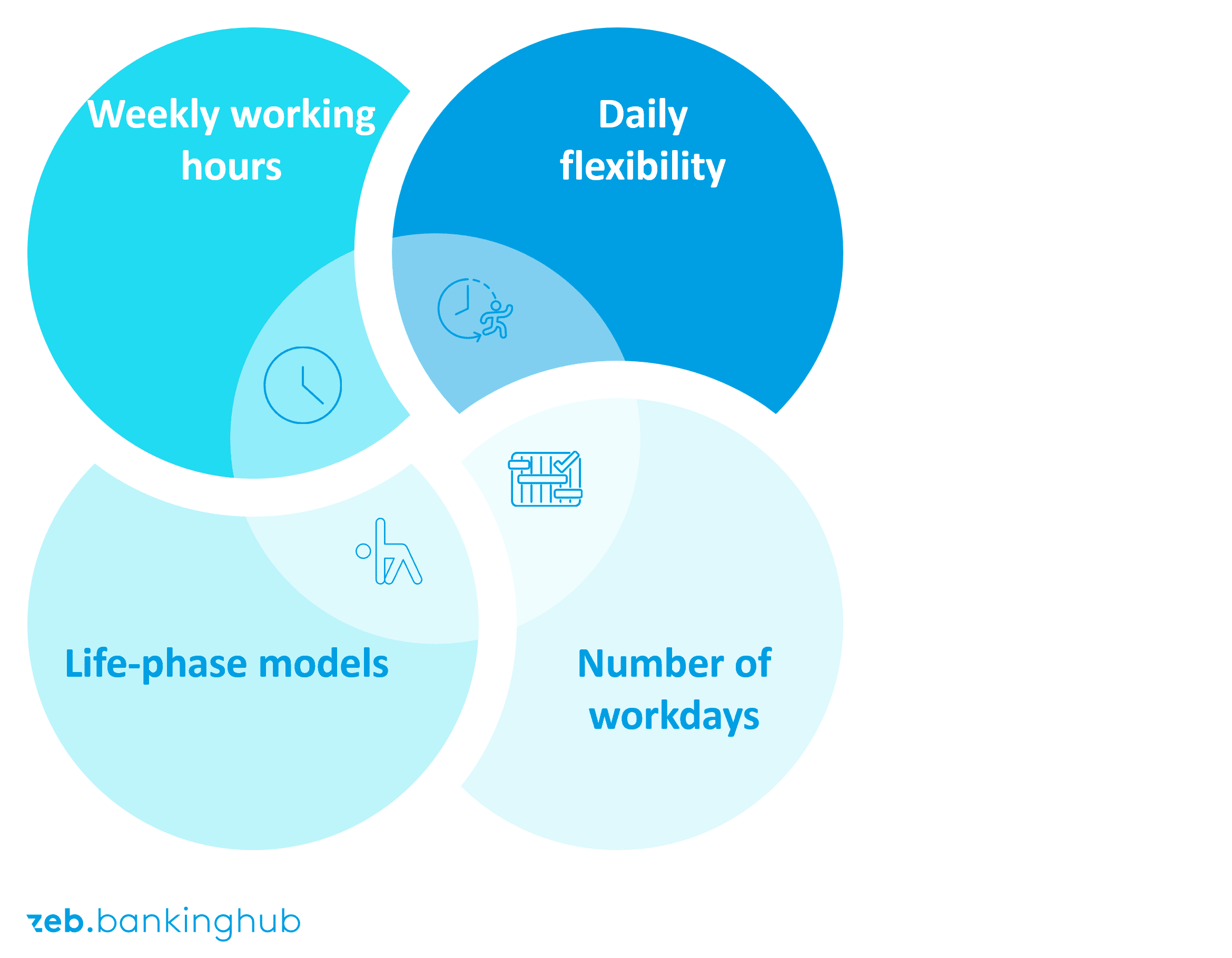
1) Weekly working hours
Reducing or increasing weekly working hours creates scope for different life models. There are two levers for this:
- Varying working hours (short-term lever): within an agreed framework, e.g. 32–38 hours/week, compensation via a working time account within a defined period of time
- Selecting fixed weekly hours (permanent lever): e.g. 32/36/39 hours, change at defined times (e.g. quarterly) or at certain phases of life
2) Daily flexibility
Flextime policy, focus times and remote working increase self-determination. Common team rules for availability and handover reports are important to ensure that flexibility does not lead to friction.
3) Number of workdays
Distribution models (4‑, 5‑, 6‑day workweek) have an effect on capacity utilization, service times and availability for customers. Active scheduling is crucial. There are two types of basic logics:
- Bundling advisory services: e.g. 3–4 fixed days/slots for advisory services per week; higher appointment rates, less inactivity
- Extending service hours: e.g. to more days/evenings; better availability, but more detailed scheduling of shifts
4) Life-phase models
Sabbaticals, further training periods, care leave policies or working time accounts allow real flexibility according to individual life situations. This is what makes employees want to stay rather than leave.
How does leadership influence the success of a working time concept?
A successful working time concept has to be consistently aimed at the target groups. Working time models are only effective if life phase and job profiles are clearly specified. Who works when, on what tasks and at what peak times?
Typical target groups can be young professionals, parents, golden agers or advancement-oriented performers, whose individual needs must be taken into account:
- Young professionals: time for learning and exam seasons; motivation to work more during peak workloads, with compensation components; remote working for phases of intense concentration and a better work-life balance
- Parents: reliable working time planning on the one hand, flextime to be able to react spontaneously to unforeseen events on the other; flexible weekly working time options without disadvantages for career paths; specific days for advisory services /appointments
- Golden agers: models of gradual reduction in working hours; mentoring opportunities for knowledge transfer; health-oriented workplace design
- Advancement-oriented performers: high level of time sovereignty; flexible daily working hours (early/late slots depending on individual needs), Saturday as optional workday without increasing total weekly hours; possibility of overtime during peak workloads with compensation options in the form of vacation / working time accounts
Once the working time models have been designed based on the target groups, the management decides on their effectiveness in real-life implementation. Only if the models are visibly exemplified and equipped with resources will they prevail against unwritten rules and expectations (e.g. “Only those who work plenty of hours can advance their career”).
The following aspects are particularly important here:
- Board commitment to make sure that the principles (such as availability, role model behavior or fairness) are communicated clearly, resources (budget and time) are provided and the decision is consistently affirmed
- Qualification of management to make sure that managers are able to handle capacities and deadlines efficiently, prioritize issues and identify potential conflicts early on
- Definition of rules that provide orientation along guidelines for availability and behavior in the event of escalations
How does the 4-day workweek work in real life compared to the 6-day workweek?
4‑day workweek (with constant opening hours)
Many organizations report stable to slightly increasing productivity, more efficient use of office time and higher appointment rates. Health effects (less stress, fewer sick days) and increased satisfaction are key drivers of lower staff turnover.
The 4-day workweek is very present in the public debate and seems to be gaining more and more popularity. However, it can only succeed if sufficient staff are available to continue to cover service times, capacities are managed meticulously and the concept is based on voluntary participation and flexibility.
According to the Institute of Economic and Social Research of the Hans Böckler Foundation, 17% of full-time employees do not approve a 4-day workweek. The reason for this objection that is most frequently given by respondents is that they enjoy and identify with their work. If a 4-day workweek were made compulsory for everyone, these top performers would lose their motivation for work, which impairs their performance, or would even change employers.
Distribution of weekly working hours over 6 workdays
More than 50% of women in regional banks work part-time. The most common reason for this is to secure childcare. Young families are often faced with the challenge that the childcare hours offered by daycare facilities are too short, that there is no childcare available at schools or that the extended family cannot help with childcare.
Often, the only solution for these families is to reduce weekly working hours. Distributing weekly working hours over 6 days instead of the usual 5 can create more flexibility for employees in certain situations. This way, young families have to put up with fewer financial losses and are still able to secure childcare.
In banks, 6 workdays are currently rather unusual and Saturday is excluded as a regular workday in most company agreements. This is a starting point for the company agreement to allow for a targeted, selective opening, in this case optional work on Saturdays without overtime.
Regional banks could use such an agreement to reach additional target groups: young families can schedule additional working slots to avoid greater loss of income without compromising on childcare, while at the same time employers can cover peak workloads or vacancies at short notice with available staff capacities – a win-win situation for both sides.
A 6-day workweek can also be interesting for advancement-oriented performers in order to work more in the short term and compensate for this in the long term through comp time or additional vacation.
The following two examples illustrate the relevance of the model:
- Anna, customer advisor (2 children, 80% part-time contract): Daycare times and school afternoons hardly allow for longer workdays. A Saturday slot from 9 a.m. to 12 noon every two weeks enables her to take on additional customer appointments. Result: She can increase her working hours from 80% to 85–90%, distributed over short, scheduled slots without disrupting her day-to-day family life. The team increases its availability and the appointment rate.
- Luca, high potential employee in CSC/video (full-time contract): During a campaign, he freely chooses to work on one Saturday a month. He uses this comp time for a four-week trip through Australia. Result: In customer segments that are easier to reach outside standard hours, the bank can conclude more deals without additional work in the weekly balance. At the same time, this flexibility increases Luca’s loyalty towards his employer.
This model is not attractive to all employees across the board, but it creates targeted flexibility for certain phases of life and needs.
Road map: seven steps towards a comprehensive working time concept
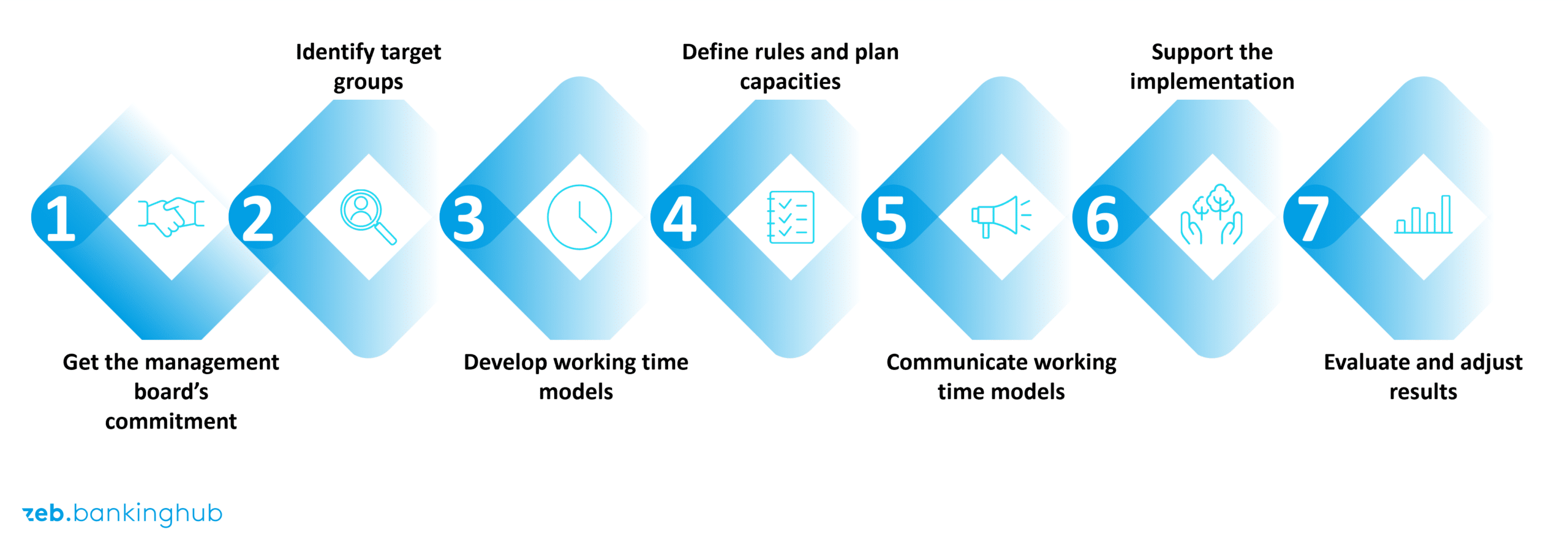
- Get the board’s commitment: The management board must really endorse the idea of alternative working time concepts and set initial guidelines, define clear principles and set an example during the implementation phase. It should also involve the works and staff councils at an early stage.
- Identify target groups: First, it’s important to define the target groups that are to be addressed with the working time concept (e.g. golden agers or young professionals). For these groups, you need to derive life-phase requirements along the individual fields of activity.
- Develop working time models: Develop modular components – from the 4-day workweek to life-phase-oriented working time accounts – by involving employees and managers alike. Do not underestimate the need for normative regulation (e.g. insolvency protection for working time accounts).
- Define rules and plan capacities: A recent zeb study on improving performance confirms the importance of team collaboration. It’s crucial to stipulate rules for availability, handover reports, focus times and substitutions. Inform managers of the results early on and, if necessary, train them in priority and capacity management. Models, rules and the forecast model usage help to plan capacities and staffing requirements and to meet the respective needs.
- Communicate working time models: Inform all employees adequately, make the rules transparent and explain the next implementation steps.
- Support the implementation: Closely monitor the implementation in the first weeks and months. Unwritten rules, e.g. overtime as a prerequisite for promotion, must be broken. This requires psychological safety, but also open-mindedness. Proactive feedback is necessary to resolve any initial friction quickly.
- Evaluate and adjust results: After 3, 6 and 12 months, measure the impact and benefits, derive findings and enhance the models. Reasonable metrics for this include:
- appointment rate
- utilization of work slots on Saturdays
- sickness rate
- part-time to full-time conversions
- number of applications
- turnover
How can typical pitfalls in the implementation of working time concepts be avoided?
Culture has a stronger impact than fringe benefits: Informal expectations (e.g. constant availability) impair the working time concept. Therefore, define guidelines in the management board at an early stage and get everyone’s commitment.
Codetermination integrated too late: The works or staff council is not involved in good time during the conceptual design process. Gain acceptance by informing codetermination committees early in the process and asking them for their ideas.
Compulsory instead of voluntary: Compulsory work shifts lower acceptance and increase the burden. It is better to create a voluntary offer with incentives such as additional vacation entitlement.
Unclear rules: Without clear guidelines, coordination costs and friction will erode the intended efficiency gains. A lack of coordination within the team leads to unclear expectations, misunderstandings and conflicts. Managers are responsible for defining responsibilities, setting availability standards and establishing handover processes.
“One‑off project” instead of continuous learning: Evaluation and follow-up are part of the concept. Employees’ expectations and life phases change. That’s why the concept must adapt accordingly in order to successfully meet the needs of organizations and employees.
A good working time concept combines flexibility and efficiency – in the interests of employees, customers and profitability. Those who take a structured approach, use data and strengthen leadership will gain in attractiveness, productivity and resilience.