What factors are driving structural transformation in the cooperative banking sector?
Cooperative banks with total assets of less than EUR 1 billion have been undergoing profound structural changes for years. Since 2000, the number of these institutions has fallen by around 76%, that is from 1,556 to just 370 in 2024. The main drivers of this development are increasing regulatory requirements and demographic changes.
Especially for smaller institutions, critical sizes are becoming a relevant strategic factor, as economies of scale in organization and IT, in regulation as well as in management and control processes can only be realized efficiently above a certain size. At the same time, the so-called “interest-rate hike” of 2023 and 2024, which noticeably stabilized the income statements of many banks, is gradually receding. Against this backdrop, medium-sized institutions are being called upon more than ever to regularly review their business models and make use of structural advantages through larger units.
This development is being aggravated by the ongoing pressure to digitalize, which requires high levels of investment, as well as by the demographic trend in the workforce: by 2030, around 30% of employees will retire due to age. In this context, mergers can broaden the workforce and enable targeted succession management. They also help to distribute the regulatory burden more efficiently and to sustainably develop the necessary competencies. Properly implemented mergers are therefore not just a response to external pressure, but a strategic opportunity to safeguard the future viability and sustainability of small cooperative banks and to combine their regional strength with a modern infrastructure.
What does the complex path from the initial merger idea to a firm partnership look like?
For many smaller cooperative banks, mergers are a strategic response to the market environment’s diverse challenges and always need to focus on members and customers. However, the process between the fundamental decision to merge and its actual implementation is complex and poses particular challenges for institutions with total assets of less than EUR 1 billion. Internal resources are frequently limited while management is heavily involved in day-to-day operations. This complicates both strategic preparation and the necessary internal and external communication. Often there is simply not enough time to deal with all the relevant issues in the necessary depth.
This makes it all the more important to adopt a structured approach that includes strategic, economic, cultural and organizational aspects at an early stage. External impetus and support from experienced partners can provide valuable orientation. At the same time, the initiation phase already harbors communication risks: communicating information too early or without coordination can cause uncertainty among representatives/members or employees. It all comes down to a transparent exploratory phase that maintains a sense of proportion and a clear strategic framework while taking into account the limited resources of small institutions.
“For small banks, a merger is a strenuous effort – limited resources, high regulatory requirements and cultural integration make the process particularly challenging,” emphasize Karl Magenau and Matthias Hillenbrand, board members of Raiffeisenbank Rosenstein eG, which plans to merge with Abtsgmünder Bank -Raiffeisen- eG this year to form a cooperative bank in the Ostalbkreis administrative district with a volume of around EUR 650 million. Karl Heinz Gropper and Danny Dürrich, their counterparts from the partner bank’s board of directors, add: “In a complex merger process, having an experienced partner at your side is all the more decisive – we know that with zeb, we get the best technical and organizational support.”
What is the key to the successful operational implementation of merger projects?
The decision to merge is only the first step. The real challenge lies in implementing it across various fields of action – with limited human and financial resources. A lean and clearly structured project organization is a key success factor and typically consists of a steering committee as the higher-level decision-making body, a central project management to manage the overall project and various subprojects for operational implementation (see Figure 1).
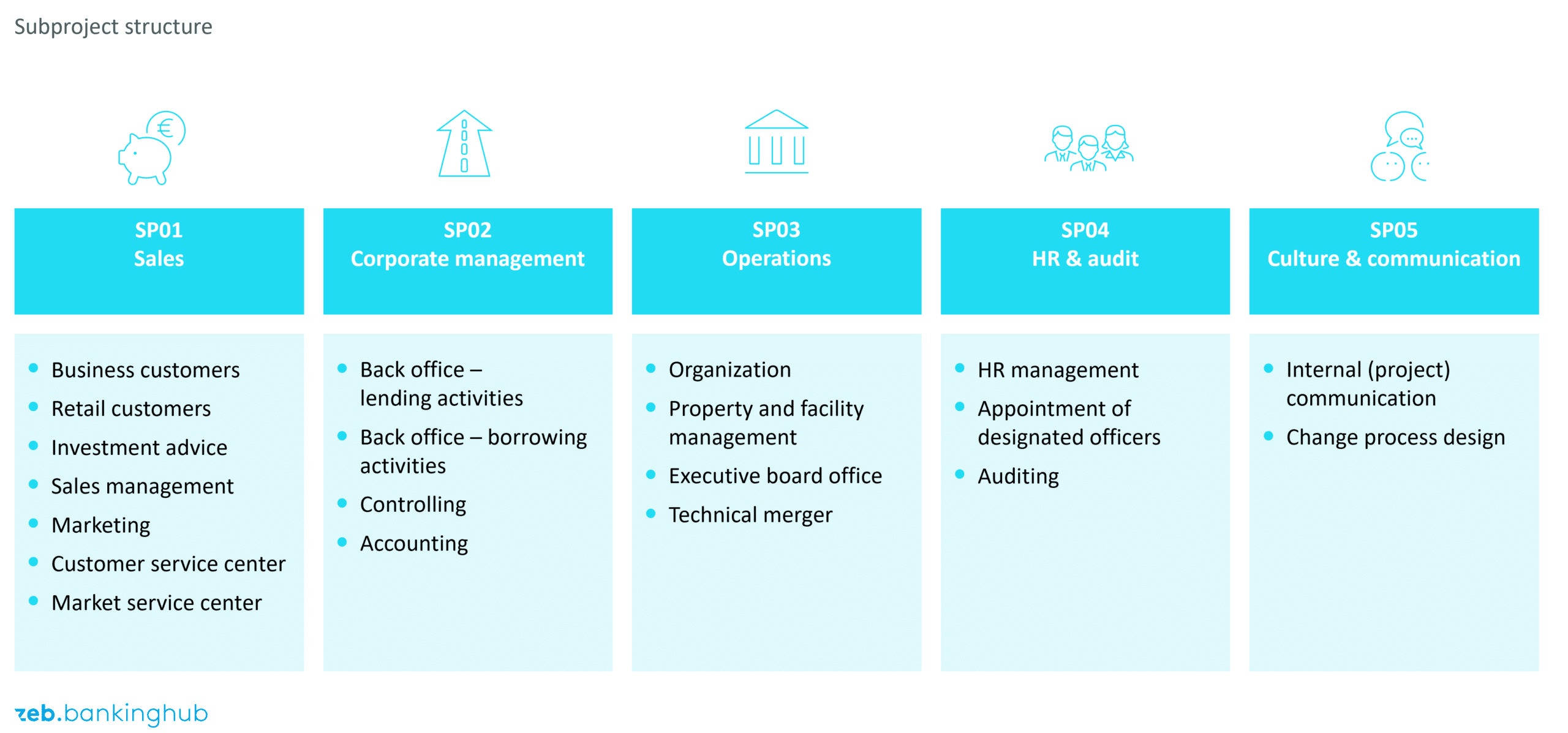
This is supported by a merger-specific milestone plan that systematically maps all relevant merger areas and prepares the legal, organizational, business and technical merger. The “heart” of the merger implementation consists of approximately 200 required decision papers that are discussed in ten steering committee meetings and ensure a structured and smooth process.
What conclusions can be drawn from the strategic opportunities and practical challenges?
Mergers are not a foregone conclusion for small cooperative banks, but rather a complex change process that requires both sound strategic preparation and consistent operational implementation. The challenges lie not only in the decision-making process, but also in the practical implementation: limited resources and the heavy burden of day-to-day business pose huge obstacles for many institutions.
At the same time, mergers offer the opportunity to overcome structural weaknesses, pool expertise and ensure long-term viability. Especially mergers between partners of roughly the same size make it possible to preserve regional identity and cooperative values and even enhance them. This creates space for actively shaping things, for further developing the business model and for remaining deeply rooted in the region.
It is crucial that mergers not only make sense from a business perspective but are also supported professionally in terms of culture and communication. Only then can they develop their full potential – as a strategic lever for stability, resilience and future viability in the cooperative banking sector.