So, what now?
Bank stock gains above the market average
- Following the significant share price gains in Q2 2026, total shareholder returns continued to rise in Q3. However, market momentum slowed considerably, as reflected in the MSCI World. Alongside energy and basic materials stocks, banks were among the biggest winners.
- The global top 100 banks delivered above-average performance in the past quarter (TSR +5.4% QoQ), continuing their recovery from Q2. Western European and BRICS banks were particularly strong performers.
Higher interest rates amid partly more resilient growth
- The growth outlook in Germany has improved, and the euro area is proving more resilient than previously expected: In Q3, the German economy is expected to grow by about 1.1% YoY, driven in particular by higher infrastructure and defense spending. A self-sustaining economic recovery is still uncertain considering that private investment remains moderate. At the same time, persistent inflationary pressures prompted the ECB and the Fed to further raise interest rates in September.
- Banks in the U.S. and Western Europe are increasing their profitability. U.S. banks posted an ROE of 16.0% in Q2 (+5.3%P YoY) with profit growth of +61.5% YoY, driven primarily by the strong capital markets environment. Western European institutions posted an ROE of 13.8% (+1.2%P YoY).
How did the world’s largest banks perform in Q3 2026?
Market momentum slows, bank stocks increase above average
Following strong investor gains in Q2 2026 (MSCI World TSR: +14.8%; global top 100 banks: +13.1%), market momentum slowed in Q3, partly reflecting interest rate hikes by the ECB and Fed. The MSCI World recorded a TSR of just 2.6% QoQ in Q3 2026, compared with 5.4% QoQ for the global top 100 banks, which outperformed the MSCI World for the first time since Q4 2025. BRICS banks, which had largely missed out on the Q2 recovery, caught up strongly (TSR +14.2% QoQ), while European banks (+4.7%) also outperformed the broader market. In contrast, US banks lost value (Q3 2026 TSR: -2.7%) despite strong quarterly earnings. Expectations of softer capital markets activity following the exceptional Q2 results, rising deposit costs and potential adverse effects of further interest rate hikes weighed on the sector. Additional pressure came from growing concerns over a potential increase in credit costs, particularly in (commercial) real estate.
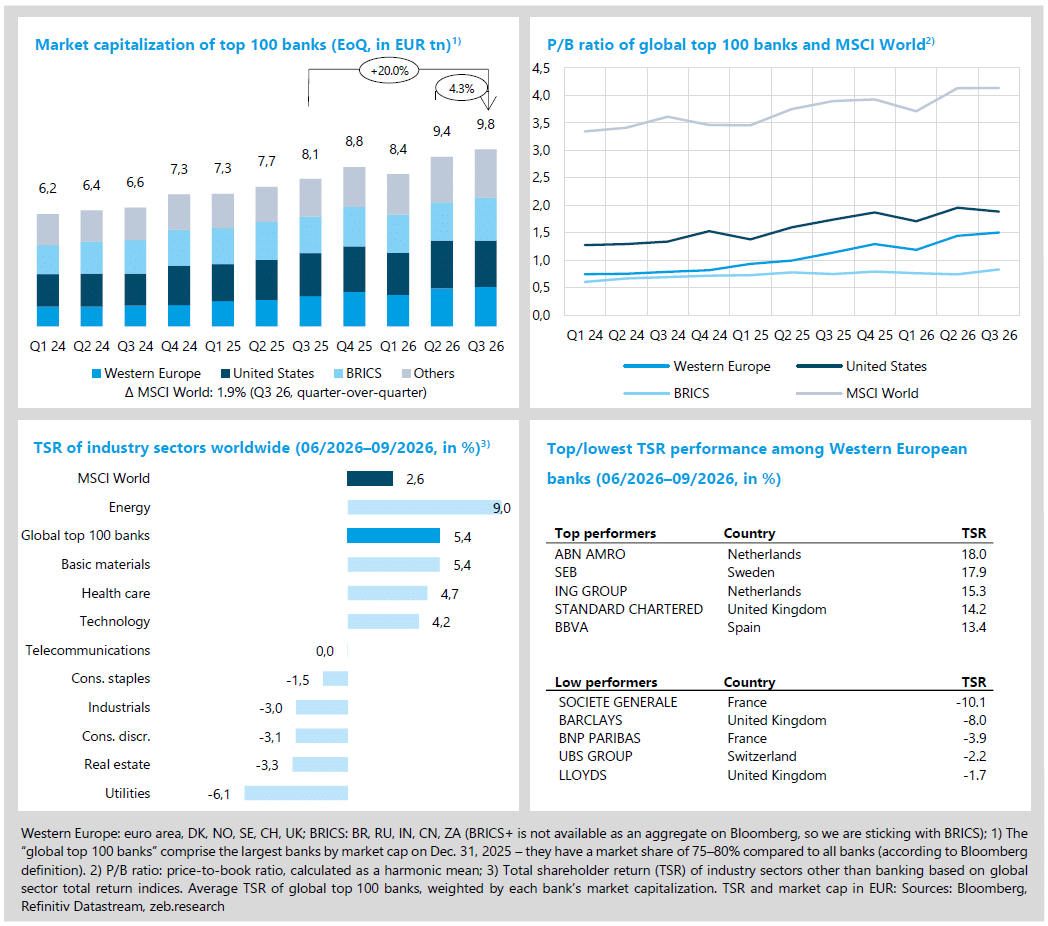
- Several sectors contributed to the market’s positive TSR in Q3. Interest-rate-sensitive sectors, such as real estate and utilities, posted negative returns. In addition to the ECB’s and the Fed’s most recent interest rate decisions, the prospect of further rate hikes (at least in the U.S.) is also dampening expectations.
- The market capitalization (+4.3% QoQ) and TSR (+5.4% QoQ) of the global top 100 banks continued to rise. The P/B ratio of Western European banks exceeded the 50× mark for the first time.
- Top TSR performers such as ABN AMRO, ING and SEB benefited from strong Q3 results that exceeded expectations; at ABN AMRO, the completion of the NIBC acquisition was also well received. French banks, in particular Société Générale, came under pressure due to rising sovereign risks and weak growth prospects. Despite strong results, Barclays was weighed down by equities trading that fell short of high expectations, as well as higher cost projections for Q3 and Q4.
Inflation pressures central banks – growth proves more resilient
Growth prospects in Germany improved in the second quarter of 2026. Following real GDP growth of 1.0% YoY in Q2, the German economy is expected to expand by around 1.1% YoY in Q3. The euro area has also proven more resilient than expected at mid-year, despite geopolitical uncertainties and higher energy prices. In Germany, key growth drivers include stronger exports and rising government spending, particularly on infrastructure and defence. However, whether this will translate into a self-sustaining recovery remains uncertain: public spending currently accounts for around half of economic growth, while subdued private investment and structural competitiveness remain key challenges. Private investment across the euro area also remained weak in Q2. The US economy remains more resilient, with growth of around 1.7% in Q3, although momentum has slowed compared to Q2 (2.2% YoY). Growth continues to be disproportionately driven by AI and technology investments as well as consumption among higher-income households.
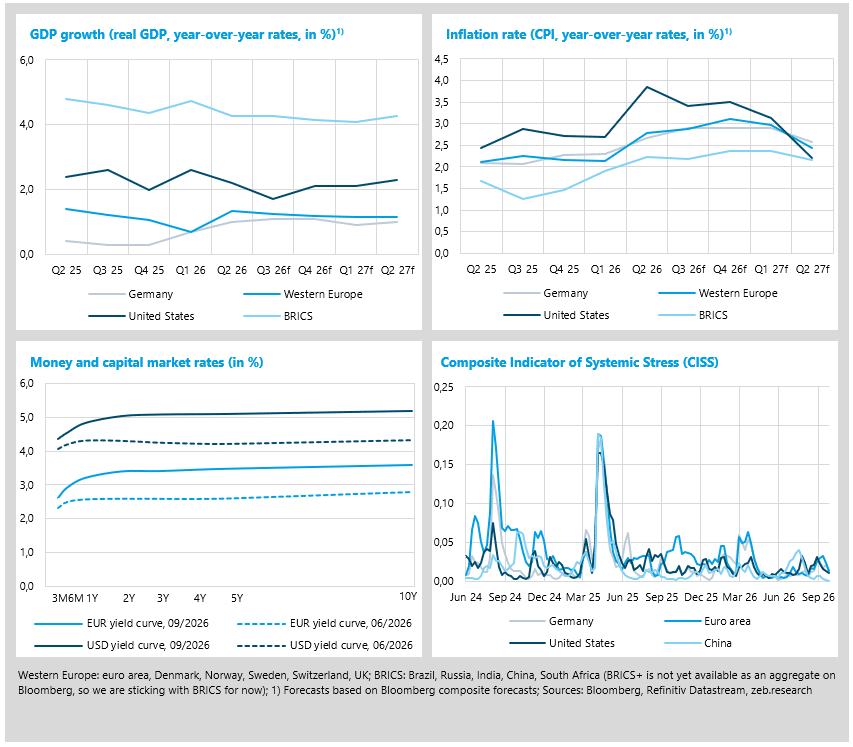
- Persistently high energy prices are increasing inflationary pressure on both sides of the Atlantic: In the euro area, headline inflation stood at around 8% YoY in Q2 and is expected to reach 2.9% in Q3; in the U.S., inflation is projected at 3.4% in Q3, down from 3.9% in Q2. Encouragingly, core and services inflation in the euro area have remained stable, suggesting limited second-round effects. Against this backdrop, the ECB and Fed each raised key interest rates by 25 basis points in September – the ECB for the second time in 2026 and the Fed for the first.
- The more restrictive monetary policy has shifted the yield curves significantly upward in Q3: 10Y yields rose by about 78 bp in the euro area and by about 85 bp in the U.S. At the same time, the yield curves steepened significantly relative to the short end: The 10Y–3M spread in the euro area widened from 48 to 96 bp (U.S.: from 27 to 82 bp).
US banks recorded an exceptionally strong increase in profitability in Q2 2026. Return on equity (RoE) among US banks rose to 16.0% (+5.3 pp YoY; +2.3 pp QoQ), while net income increased significantly by 61.5% YoY. Performance was particularly strong among the top five US banks, which benefited from a highly dynamic capital markets environment: Elevated IPO and M&A activity, combined with strong trading performance, contributed to substantial revenue growth. This positive development was further supported by robust lending activity, solid net interest income and persistently low credit risk costs. Western European banks also recorded improvements in profitability, although to a somewhat lesser extent: ROE increased to 13.8% (+1.2 pp YoY), accompanied by net income growth of 15.6% YoY. Key drivers included an increase in non-interest income, albeit less pronounced than in the US, continued strong cost discipline and a solid contribution from net interest income.
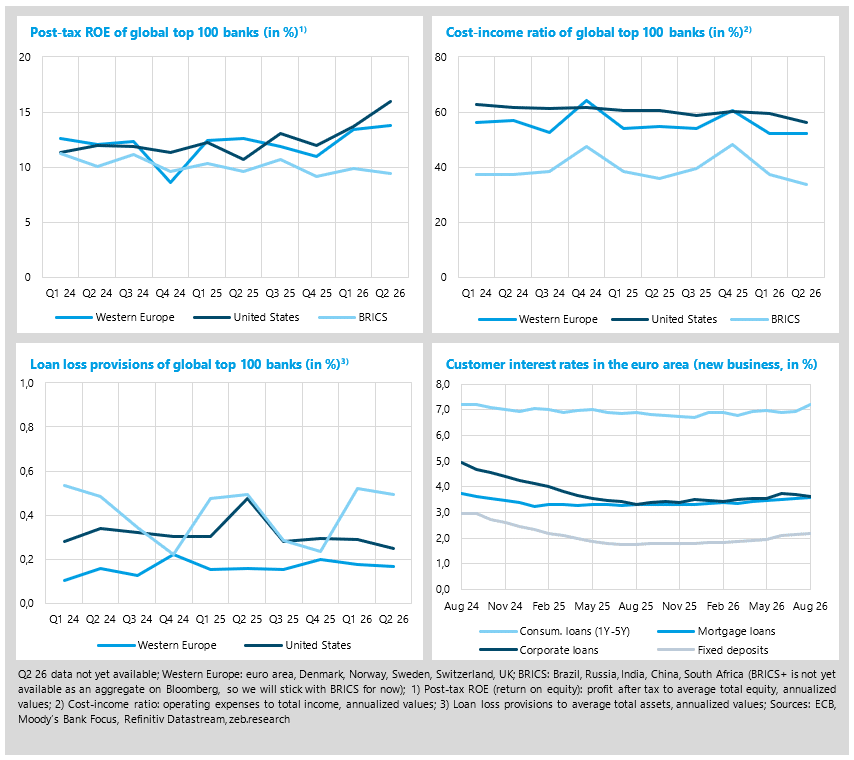
- Cost-to-income ratios improved significantly in Q2: In the U.S., income grew by 24.7% YoY, significantly outpacing the increase in costs (3.3% YoY), thus causing the CIR to decline by 4.3%P to 56.1%. Western European banks also improved their efficiency; with an income growth of +10.4% YoY versus a cost growth of +5.2% YoY, the CIR fell by 2.5%P to 1%.
- LLP ratios remained low: In Western Europe, the LLP ratio fell slightly to 0.17% (-1 bp QoQ); in the U.S., it fell to 0.25% (-4 bp QoQ). The YoY comparison for the U.S. is distorted by Capital One’s exceptionally strong retirement provisioning business in Q2 2025.
- Consumer interest rates in the euro area mostly rose from June through August. Main drivers were the ECB’s interest rate hike in June and the expected further rate hike in September. Interest rates on consumer loans rose particularly sharply (+33 bp to 7.21%), while those on mortgages and time deposits rose more moderately (both +9 bp). By contrast, corporate loan rates fell by 10 bp to 3.63%, primarily as a result of normalization following the sharp increase in June.