EU Green Bond Standard what is it about?
In the 2015 Paris Climate Agreement, the EU countries pledged to achieve complete climate neutrality by 2050. Achieving this goal will require extensive investment in environmentally sustainable projects and technologies.
With the EU Green Bond Standard (EU GBS), the European Union has created a common framework for the issuance of green bonds. It aims to establish consistent guidelines at EU level for the allocation of funds from such financing instruments and to significantly boost market liquidity for “green” bonds.
Following a first consultation version in June 2019, the European Union adopted Regulation (EU) 2023/2631 on European Green Bonds at the end of 2023. Since its entry into force on December 20, 2024, issuers have had the option of issuing bonds as European Green Bonds (EuGB). For now, its adoption remains voluntary.
Below, we outline the requirements and components of the EU GBS and its relevance to sustainable finance. We also compare it with other green bond certifications, such as the ICMA GBP and the vdp standard. Finally, we highlight opportunities and risks, including possible courses of action for banks.
Issuers opting to issue their bonds under the EU GBS must ensure that the funds finance environmentally sustainable projects, similar to the ICMA GBP. Key requirements include allocation of funds, reporting and external review specifications.
How should the funds for green products be used?
The core component of the EU GBS is the application of the EU taxonomy to classify “green” projects. At least 85% of the proceeds of the bond issuance must be used for environmentally sustainable purposes in line with the requirements of the EU taxonomy. A 15% flexibility quota also allows investments in activities and sectors not yet covered by the EU taxonomy during the transition period until all assessment criteria of the taxonomy have been adopted
If the technical assessment criteria change after a green bond has been issued, there is a grandfathering period of up to seven years before issuers are required to use the proceeds in accordance with the new criteria.
Reporting: What are the reporting obligations?
In addition to the application of the EU taxonomy, extensive reporting and information obligations on the part of issuers throughout the life cycle of a European green bond are intended to ensure transparency for investors regarding fund allocation. In Germany, BaFin as the responsible supervisory authority monitors compliance with these obligations.
In accordance with the Regulation, a securities prospectus and an information sheet (European Green Bond Factsheet) must be published prior to the actual issuance. The latter contains information on the planned use of the proceeds and sets out how the bond is intended to contribute to the overarching objectives of the issuer’s environmental strategy. This is to help investors make informed investment decisions.
To ensure that the proceeds are used appropriately, the issuer must provide transparency. To this end, they must prepare an annual allocation report from the date of issuance until the proceeds have been fully used, disclosing the contributions made to green projects from the proceeds of the bond issuance. In addition, an impact report on the actual environmental impact of the bond (e.g. in terms of carbon reductions) must be published at least once during the bond’s term and after all proceeds have been used in full.
What are the transparency and auditing requirements?
The European Green Bond Regulation mandates pre- and post-issuance reviews of these reports. External reviewers must verify the information in the factsheet and the final allocation report, which is prepared after the proceeds have been fully allocated. While the downstream impact report is generally exempt from mandatory reviews, it can be inspected on a voluntary basis.
To ensure a high-quality and independent review, external reviewers must be registered with ESMA[3] and meet specific requirements regarding their qualifications, experience and organization. ESMA also monitors compliance with these obligations after registration.
How much do European banks need to do in terms of ESG? Download our ESG Implementation Study!
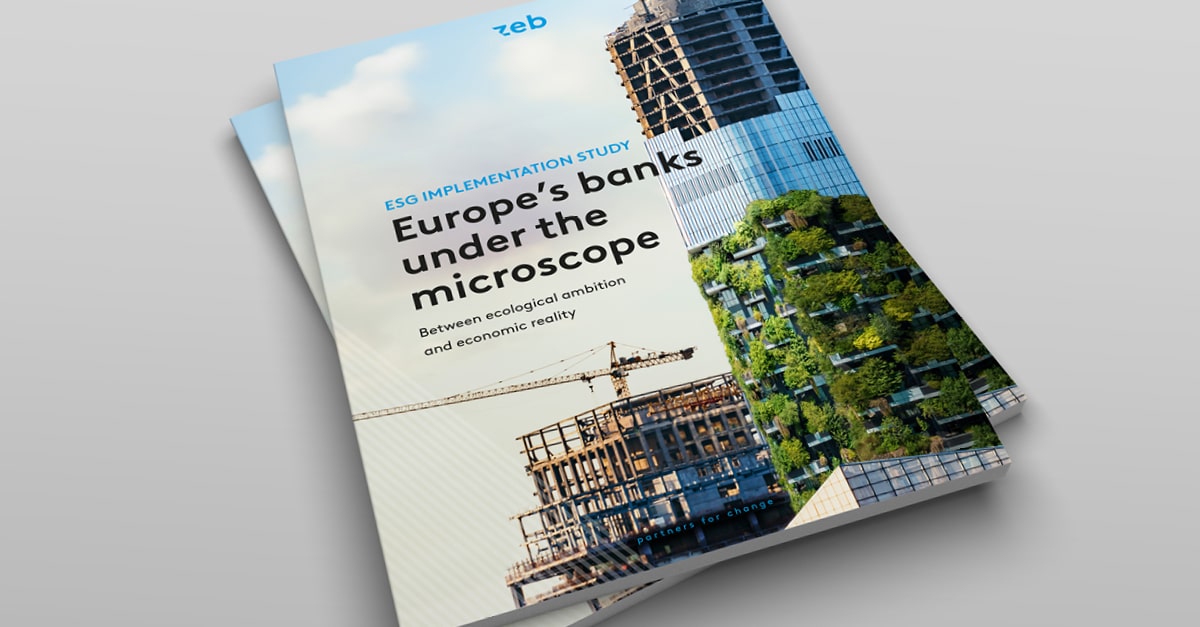
ESG Implementation Study 2024
Europe’s banks under the microscope: between ecological ambition and economic realityWhat are the differences compared to the ICMA Green Bond Principles (GBP)?
The EU GBS sets clear criteria for the financed projects, based on the EU Taxonomy. In principle, they are similar to those of the ICMA GBP, although the latter are more general and therefore leave more room for interpretation. The EU GBS reporting requirements are also more specific. This means that even an existing GBP-compliant reporting system may not guarantee the EU GBS label.
One of the biggest differences is the verification of the framework by an ESMA-accredited institution. Although some market leaders or widely recognized institutions have now established themselves for the verification of the GBP, the qualification requirements for the GBP are less stringent.
Overall, the EU Green Bond Standard offers a clearly regulated, harmonized and detailed structure for green bonds within the EU, while the ICMA GBP represent a more flexible, market-driven approach.
What are the prospects and challenges?
With the EU GBS, the market now has another standard for green bonds. For the issuing institution, the decision for or against issuing green bonds depends primarily on the following questions:
- How will investor demand develop depending on the different standards (ICMA standard, EU GBS, vdp standard)?
- Does the chosen financing instrument offer a spread cost advantage (“greenium”) compared to a traditional bond?
- What effort is required to meet the associated criteria (in particular, what is the initial effort, e.g. to create the appropriate requirements for the classification of green assets)?
- Can a sufficiently large volume of green assets be achieved under the chosen standard?
As described in the previous article in this series, these four questions can be answered by analyzing the market environment, comparing the different types of bonds (ICMA GBP, green covered bonds from the vdp, sustainability-linked bonds, social bonds, etc.) and calculating the profitability.
What are the vdp’s requirements?
The Association of German Pfandbrief Banks (vdp)[4] represents the interests of German Pfandbrief banks and is committed to the future viability of the established German Pfandbrief with its impeccable credit history.
In 2019, the banks organized in the vdp developed minimum standards that Pfandbrief banks must meet if they wish to issue Green Hypothekenpfandbriefe (mortgage-backed bonds) or Green Öffentliche Pfandbriefe (public covered bonds). This effort is intended to give further impetus to the market for Green Pfandbriefe and to provide useful guidance for active and potential issuers as well as interested investors.
A first revision already came into force on January 1, 2025, in which the criteria for green assets were aligned more closely with the EU Taxonomy.
The issuance of a Green Pfandbrief as defined by the vdp is not only based on the relevant regulations for mortgage-backed bonds and the ICMA Green Bond Principles applicable at the time of issuance, but also on the respective provisions of the German Pfandbrief Act (Pfandbriefgesetz). The issuer of the bond is obliged to draw up and publish a green bond framework prior to the issuance.
In addition, if the issuer uses the vdp word marks (Grüner Pfandbrief / Green Pfandbrief), they are obliged to conclude a separate trademark license agreement with the vdp and to comply with the following minimum standards, which can be divided into four subcategories.
I) Financing of existing residential properties
Financing of existing residential properties must meet at least one of the following criteria.
- The property in question must have an energy efficiency rating of B (or higher). As of 2025, the property must be capable of achieving at least energy efficiency class A.
- The energy demand must not exceed 75 kilowatt hours per square meter. As of 2025, this criterion no longer applies.
- Co-financing is provided through KfW development programs for energy-efficient construction and renovation.
- Energy consumption/demand is within the bottom 15% of the national or regional property portfolio.
II) Financing of existing commercial properties
A minimum requirement for the financing of commercial properties is compliance with one of the following criteria.
- The benchmark values published by the German Federal Ministry for Economic Affairs and Energy and the German Federal Ministry for the Environment, Nature Conservation, Building and Nuclear Safety (April 7, 2015) must be met. As of 2025, commercial properties must fulfill the requirements for allocation into energy efficiency class A at least.
- A sustainability certificate from an established provider is available that allocates the property into one of the top categories.
- Energy consumption/demand is in the bottom 15% of the national or regional commercial property portfolio (similar to existing residential property financing).
III) Financing of new buildings[5]
- The property is located in Germany: At a minimum, the property meets the statutory energy standards for new buildings in effect at the time of financing. As of 2025, the property must have a primary energy demand that is at least 10% below the national standard for nearly-zero energy buildings (NZEBs[6]).
- The property is located in a foreign country: The locally applicable national energy standards for new buildings are complied with. As of 2025, properties in the EU must have a primary energy demand that is at least 10% below the national standard for nearly-zero energy buildings. Properties outside the EU must comply with the locally applicable national energy standards for new buildings.
IV) Financing of renovations or refurbishments
- The reduction in energy consumption or demand is at least 30%.
- This enables the property to achieve a level in line with the EU’s climate targets.
The vdp regularly reviews these minimum standards for Green Pfandbriefe to adapt them to current market developments where necessary. The overall objective is to make a contribution to achieving the climate targets. For the German building sector, this means a targeted reduction of carbon emissions to around 70 million tons by 2030 and achieving carbon neutrality by 2050.
The Green Pfandbrief seal described above is intended to help give the banks organized in the vdp more credibility regarding sustainable activities and to increase transparency for investors. The standardization of Green Pfandbriefe can also reduce the time and effort involved for the individual banks.
Conclusion: green bonds are here to stay – is that true?
The EU GBS paves the way for a common and specific framework for the issuance of green bonds in the EU. It specifies or supplements the ICMA Green Bond Principles in some areas and, in particular, integrates the requirements of the EU Taxonomy. At national level, the vdp has engaged in concretizing the ICMA and EU standards for the German Pfandbrief. These initiatives underscore the growing relevance of green and sustainable bond issuances.
Future issuances should therefore be in line with the EU GBS and at the same time comply with the ICMA GBP. For Pfandbrief banks, the vdp requirements for a Green Pfandbrief should also be taken into account.
zeb can assist in setting up an issuing bank’s green bond framework in accordance with the EU GBS and ensuring that the GBP and, if applicable, the vdp requirements are met at the same time. We also provide support in achieving green bond issuance capability, e.g. as part of the business case calculation or in selecting the appropriate framework standard (see the second article in our series “Green funding: the path to green bond issuance capability”).