Leadership 4.0 – what is it actually about and why is it relevant today?
Leadership 4.0 is more than just a buzzword. It is the answer to a world that is changing rapidly and in which traditional leadership models are losing their impact. Leadership today no longer works through hierarchy, control or professional superiority alone. Instead, it relies on trust, clear guidance and the ability to empower people and teams in a dynamic environment.
The term, which is derived from “Industry 4.0”, describes the changes in leadership in the context of digital transformation, new forms of work and changing social expectations. Leadership 4.0 introduces a new mindset and places fresh demands on leaders.
- Digitalization: Leaders need to understand and actively shape technological developments – even without being IT experts themselves. It’s about enabling digital processes, leveraging tools effectively and guiding your team through change.
- Agility: Nowadays, instead of rigid annual plans, quick, iterative decision-making is what counts. Leadership 4.0 means confidently dealing with uncertainty and empowering teams to adapt autonomously.
- New work concepts: Flexible structures, hybrid collaboration and self-organized teams are challenging leadership in new ways. More than ever, leaders must provide guidance – without dictating every step.
- Cultural transformation: Employees expect meaningful work, transparency and participation. Leadership 4.0 is based on the principle: Less order, more dialogue. Fewer commands, more responsibility. Less status, more impact.
In short: Leadership 4.0 means not having to decide everything yourself but setting the framework within which good decision-making is possible. This means doing less personally and enabling more.
Leadership 4.0 is therefore not a new leadership tool, but rather a new leadership mindset that aligns with today’s work reality and helps organizations stay ahead of the curve.
Why traditional leadership is reaching its limits today
For a long time, those who led set the direction, made decisions and oversaw their implementation. This type of leadership – planning, controlling and a top-down approach – made sense in stable environments. However, the rules of the game have changed.
Today, companies are operating in a world defined by three forces: speed, complexity and uncertainty.
In such an environment, traditional leadership models quickly reach their limits.
- Plans rarely survive reality. Long-term strategies often become outdated even before they are implemented. Those who stick to rigid directives react too slowly.
- Hierarchical knowledge is no longer enough. Leaders cannot keep track of all developments and must learn to delegate decision-making to their teams.
- Employees expect more. Nowadays, meaningfulness, participation and development opportunities count for more than instructions or status symbols. Motivating people today requires new approaches.
Traditional leadership often acts as a brake in this new reality. It results in excessive coordination instead of bold action and control instead of trust. At the same time, the pressure is mounting. The shortage of skilled workers forces organizations to harness the full potential of their employees and retain top talent long-term. This cannot be achieved with outdated leadership styles but requires a forward-looking mindset.
That is why Leadership 4.0 is not just nice-to-have, but rather a business necessity. Those who still lead with yesterday’s methods will not be able to meet tomorrow’s challenges.
Five principles of modern leadership
Leadership 4.0 is more than just a buzzword – it marks a real paradigm shift: from control to trust; from orders to guidance and from bosses to empowering leaders.
Five principles are essential for leadership to be effective in a dynamic and complex work environment:
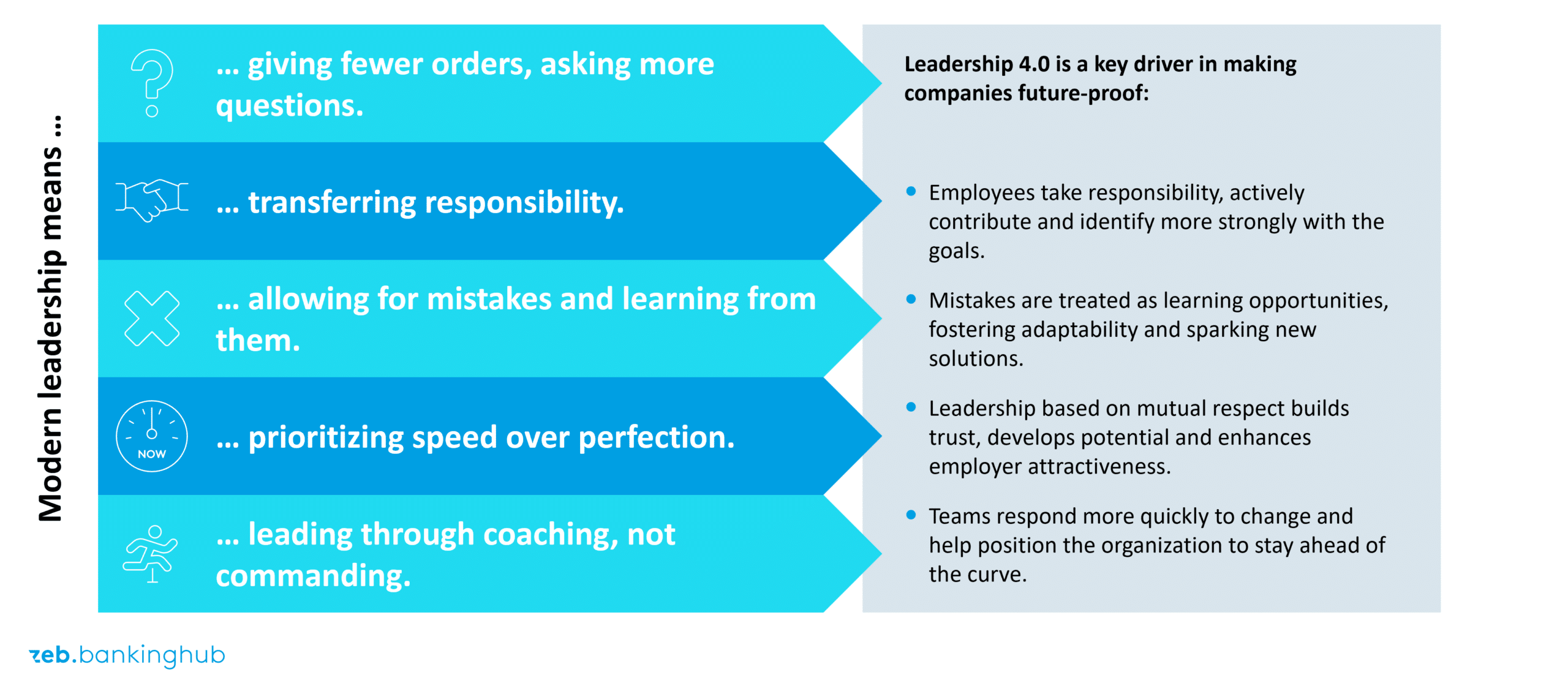
I) Give fewer orders, ask more questions
Modern leadership means creating space for collaboration. Rather than “I know how to do it”, the mindset shifts to “What is your best solution?”. Asking questions stimulates thought and unlocks knowledge in the team.
Practical tip: In meetings, specifically seek out the perspectives of employees, also from quieter voices.
II) Transfer responsibility – genuinely
Micromanagement is the opposite of trust. Leadership 4.0 means not only giving responsibility and allowing it to be accepted but also the freedom to forge one’s own path.
Practical tip: Formulate clear objectives but leave the path open. Provide support only where necessary, instead of querying every intermediate step.
III) Allow for mistakes and learn from them
Where new things are created, mistakes happen. If you want innovation, you must provide psychological security. Mistakes are not covered up but used: as a learning opportunity and source of improvement.
Practical tip: Address your own mistakes openly and actively encourage teams to reflect on learning moments.
IV) Prioritize speed over perfection
In uncertain times, the winner is the one who takes action. Rather than waiting for the “perfect solution”, the aim is to make viable decisions quickly and refine them if necessary.
Practical tip: Treat decisions as prototypes – test them, learn from them and improve them.
V) Lead through coaching, not commanding.
Today, leaders are more like coaches, mentors and guides than commanders. They help to develop potential, share knowledge and remain approachable even during difficult phases.
Practical tip: In appraisal interviews, listen more than you talk. Ask questions like “What do you need to continue growing and advancing in your role?” instead of “This is how you should do it”.
These principles sound simple – but when it comes to implementation, they require a consistent rethink. Those who internalize them, however, not only lead in a more modern way, but also more successfully. Modern leadership is no longer defined by methods – it’s shaped by mindset.
Modern leadership requires decisiveness – but not the way one might think.
In a world that is constantly changing, decisiveness is becoming a key skill. Today, however, decisiveness no longer means making all decisions on your own. Rather, it refers to the ability to recognize when a decision needs to be made quickly, shared or postponed intentionally.
Traditional decision-making processes – long, hierarchical and risk-averse – are coming under pressure. Those who wait for complete information often decide too late. Leadership 4.0 relies on bold, context-sensitive action.
Three key principles are central to this approach.
I) Prioritize speed over perfection.
The perfect decision rarely exists. In dynamic environments, it’s important to act quickly and adjust along the way.
Practical tip: Treat decisions as hypotheses: start with 70% knowledge, gain experience and refine as needed.
II) Let go when others are better positioned to decide.
Not every decision needs to be made by the leader. The best assessment often lies within the team, as they are closer to the topic and reality.
Practical tip: Instead of discussing broadly, ask specifically “Who has the best knowledge for this decision?” and then delegate with confidence.
III) Understand decision-making as a process.
Leadership 4.0 is moving away from a static understanding of decision-making. In complex situations, decisions must remain verifiable without becoming arbitrary.
Practical tip: Reflect regularly: “Is our decision still valid or does it need adjusting?”
Leadership 4.0 calls for decisiveness, but not in the traditional sense of authority and control; rather it calls for a new sense of courage, agility and mutual respect.
If you hesitate too long, you lose not only time but also trust. Decisive leaders drive progress.
Conclusion: rethinking leadership – mindset instead of hierarchy
Leadership 4.0 is not a method, a new set of tools or an agile trend. It is a new understanding of how people can work together effectively. In today’s fast-paced, complex and diverse work environment, we need facilitators who provide guidance and build trust, not omniscient leaders at the top.
It’s not about doing everything differently. It is essential to let go of the wrong things: micromanagement, decision-making monopolies and an obsession with perfection. If you want to lead, you must lead the way – not with power, but with purpose.
What are you waiting for? Take the first step today and create a leadership style that suits your vision of the future.