Is sustainability reporting merely a regulatory obligation?
While large institutions are usually required to report for regulatory reasons and have structured their organizations around these requirements for years, the situation is often less clear for regional banks.
They find themselves torn between the vague requirement to complete a regulatory box-checking exercise they would rather avoid and the strategic question of what tangible benefits sustainability reporting can deliver in light of stakeholders’ (future) expectations. In particular, this concerns how the bank positions its regional responsibility, how customers perceive it and how creditors assess it.
This area of tension puts the core issue in sharp focus: is sustainability reporting just an annoying regulatory obligation for regional banks, or does it deliver added value once costs and benefits have been weighed?
How can regional banks benefit from sustainability reporting?
For regional banks, sustainability reporting can create real added value that goes beyond regulatory obligations. It communicates the bank’s ESG risk exposure and commitment in a recognized, transparent format, showing which measures are already underway. At the same time, it strengthens credibility in corporate client relations and improves the ability to professionally respond to requirements from supervisory authorities, associated institutions and lenders. Thus, sustainability reporting becomes a strategic tool that provides direction, builds trust and sharpens the focus when looking in or out.
This benefit for stakeholders does not happen by chance: For institutions subject to the CSRD, it is already mandatory to gather the perspectives of relevant stakeholder groups. In practice, workshops have proven especially effective for systematically capturing the various expectations. What may seem like a huge effort at first pays off quickly: the bank receives direct feedback that provides both strategic guidance and implementation-focused input. Consistent stakeholder engagement improves public perception because it signals to these groups that their views are being taken seriously. For institutions that report in accordance with the VSME, this is not strictly required. Still, once a bank has gained initial reporting experience, it is worthwhile to integrate workshops with stakeholders into the annual process.
Additionally, regional banks have also built ESG strategies independent of sustainability reporting and have already implemented initial measures. Measuring and managing a bank’s direct and financed GHG emissions, for example, is playing an increasingly important role in reducing transition risks. If regional banks already measure, manage and implement measures of their own accord, they should report on them as well. Sustainability reporting in accordance with the CSRD or the VSME increases credibility because it is a recognized format for demonstrating one’s progress and positioning.
Another benefit of sustainability reporting is improved credibility, especially with corporate clients. In this context, reporting plays an important role for two reasons. First, it is a strong signal when the credit institution demonstrates that it has its own expertise and experience in sustainability reporting. This builds trust and provides a strong basis for expert advisory services to support corporate clients in their transformation. Second, systematically collecting information on how ESG risks are managed is part of every company’s risk assessment and is crucial for the regional bank’s risk management. Relationship managers in corporate banking will increasingly need to explain why certain information is necessary, even when no regulatory disclosure obligation applies. Good arguments lose their impact when the bank’s own actions do not back them up. Structured sustainability reporting therefore directly strengthens the position of relationship managers. It provides a robust evidence base, ensures clear consistency between the bank’s stated ambitions and its actual actions and increases credibility in customer communication.
In addition, sustainability reporting benefits the bank’s own rating, refinancing terms and potential capital market requirements and is already mandated in many respects. Landesbanken and top institutions of the Savings Banks Finance Group and the Cooperative Financial Network will continue to be subject to reporting obligations under the CSRD and will pass on the requirements they must meet for their own refinancing to their business partners. In this context, regional banks will likely also have to explain, in a recognized format, how they manage ESG risks, how effective their sustainability governance is and how transparently they report on their sustainability performance. This data is required for the bank’s risk analysis, for consolidating information within the group network and for meeting its reporting obligations. Even without direct capital market orientation, regional banks will be affected by these developments.
Structured sustainability reporting creates early compatibility and readiness to meet downstream requirements. It allows institutions to provide consistent, reliable information in a widely accepted format. In turn, regional banks can meet stakeholder expectations, strengthen their credibility with corporate clients and improve their refinancing conditions.
How much effort does sustainability reporting actually incur in practice?
Many regional banks initially view it as a potentially big effort. Those benefiting from the Omnibus package’s simplifications rightly question whether it makes sense to invest resources in an area without a strict regulatory obligation. This concern is not unfounded because a report does not write itself. Still, the objection carries less weight once the VSME can be applied.
In any case, it remains important to understand what truly drives effort. Only then can banks plan efficiently and execute the process with available resources.
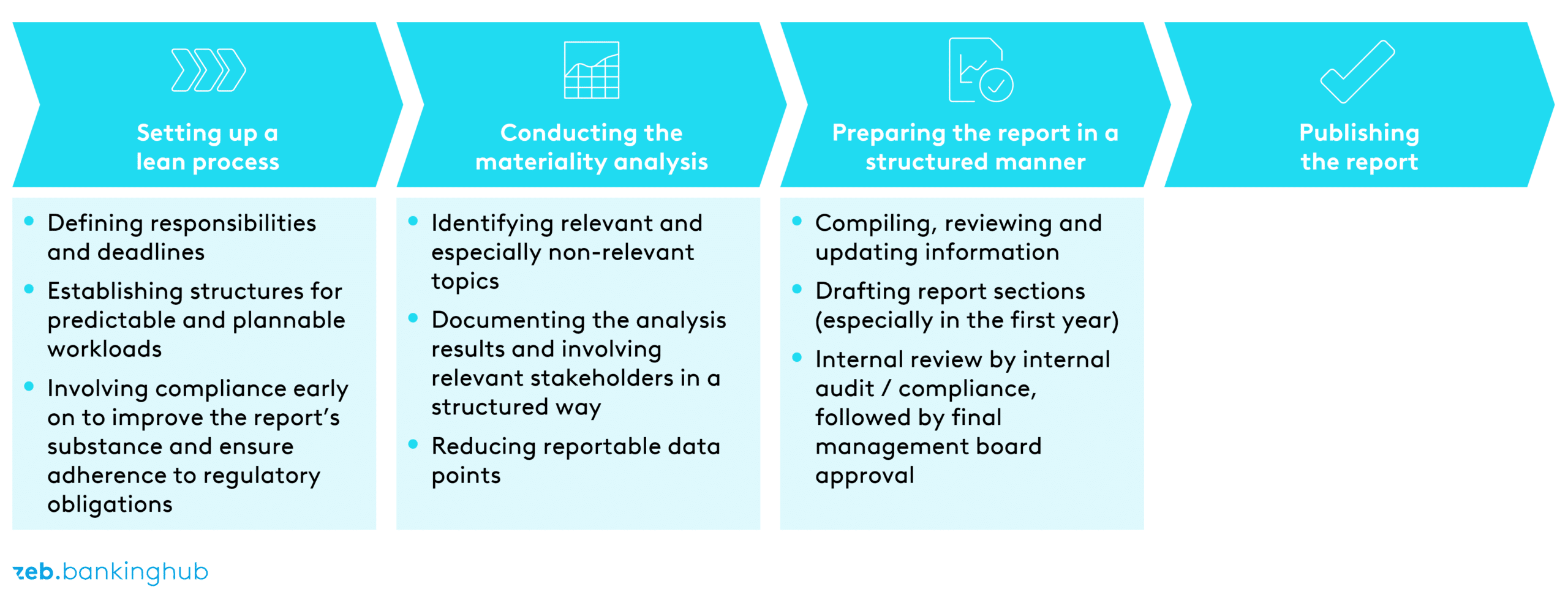
To produce a finished report, a bank goes through three main phases:
Setup of a lean process
The first question is who has to provide what information and by when. A clearly structured workflow allows for the planning of workloads at the beginning of the year, rather than requesting ad hoc information at times when employees are unavailable. Internal departments such as internal audit and compliance also benefit from a transparent structure. They are given sufficient time to understand the report and provide substantive improvements while meeting regulatory requirements.
Conducting the materiality analysis
A materiality analysis decides what the bank reports on and, just as important, what it does not. A well-documented analysis and the structured involvement of relevant stakeholders create clarity and reduce reportable data points to those that matter. The bank reports only on issues that are truly relevant to its sustainability management and are prioritized accordingly by stakeholders.
Preparing the report in a structured manner
Next, the information is compiled and reviewed to determine what data has already been provided and what still needs to be requested. Additionally, a comparison is made with the previous year’s data to identify changes. In the first year of sustainability reporting, sections of the report are drafted that can be reused in subsequent years. A well-prepared first version can thus considerably reduce the work involved in later reporting cycles. Finally, internal departments such as internal audit and compliance review the report, and the management board provides final approval.
Our project experience shows that steps one and two in particular are key drivers of effort. However, once the process is clearly defined, it largely stays in place. In later years, banks typically only update deadlines and review responsibilities.
The initial effort required to introduce sustainability reporting is therefore higher than the effort required once it is up and running. Processes must be defined, responsibilities established and data sources identified. Once the basics are in place, the incremental effort decreases significantly from year to year.
What’s more, sustainability reporting does not introduce an entirely new regulatory landscape because many elements are already expected of institutions. The following regulations represent a selection of the existing ESG obligations:
- The Minimum Requirements for Risk Management (MaRisk) demand appropriate risk management, including the assessment and recording of ESG risks.
- The Guidelines of the European Banking Authority (EBA) on credit and risk management explicitly integrate sustainability aspects and likewise require a range of review and steering actions.
- The Banking Directive Implementation and Bureaucracy Relief Act (Bankenrichtlinienumsetzungs- und Bürokratieentlastungsgesetz, BRUBEG) has further strengthened the importance of managing ESG risks.
Against this backdrop, sustainability reporting, with sound process design, is above all a structured consolidation of information that is largely readily available within the institution or the collection of which is already mandatory.
Conclusion: Sustainability reporting can be implemented efficiently with clear processes and careful preparation
For regional banks, sustainability reporting is neither an unnecessary end in itself nor a mere compliance burden. Rather, it should be seen as an opportunity. Done well, it creates a structured framework for clear strategic positioning, enables credible internal and external communication and strengthens regional responsibility as well as the capacity to adapt to an environment where transparency is increasingly expected.
Many regional banks have already embarked on this path. Others would be wise to tackle the issue pragmatically and proactively instead of putting it off. Recognizing that the initial setup requires the most effort makes it easier to stabilize established workflows or to review and refine them once initial experience has been gained. Banks that remain consistent and follow through will build a reliable foundation for future requirements and strengthen their position in the market and region, as well as with key stakeholders.