Lending standards – more than just a regulatory chore?
In many credit institutions, lending standards are still primarily seen as a regulatory necessity. In fact, however, they are far more than a formal set of rules.
Properly designed and consistently applied standards are one of the most effective levers for dovetailing risk appetite, portfolio orientation and operational credit decisions. Especially in the current environment, lending standards determine whether the risk strategy becomes effective in day-to-day business – or whether it remains a theory.
Regulation sets the framework: how do banks manage the transition to a real in-house steering effect?
Lending standards are an integral part of an institution’s risk strategy. They translate the defined risk appetite into concrete, binding guidelines for credit decisions and ensure that strategic goals do not remain abstract but are consistently implemented in business operations.
The regulatory framework is clearly defined. The Minimum Requirements for Risk Management (MaRisk) oblige banks to derive suitable measures from the risk strategy and define a qualitative and quantitative risk appetite. In addition, the EBA guidelines on loan origination and monitoring ask for a structured, comprehensible definition of lending criteria that are based on the borrower’s economic performance and the main risk drivers.
The principle is clear: while regulation defines minimum requirements, the actual steering effect is exerted by the institutions themselves. Lending standards are not an end in themselves. They only prove useful when they are consciously used as a portfolio management tool with a clear link to the business model, business and risk strategy as well as risk-bearing capacity.
How do lending standards act as a link between strategy and lending operations?
Effective credit portfolio management is not achieved by adhering to individual guidelines, but by several steering levels interacting. In practice, three levels have proved successful, as they build on each other and together form a consistent framework:
- The risk appetite defines the guiding strategy. It determines which risks the bank is generally willing to take and which are deliberately avoided. This includes statements on target customer segments, credit rating levels, industry focus and exclusion criteria.
- Structural limits specify this framework at portfolio level. They restrict risk concentrations and prevent cluster risks, for example unsecured exposure limits, exposure, country or sector limits. This allows them to manage the credit portfolio composition from an aggregated perspective.
- Lending standards form the operational implementation level. They take effect where strategy and limits are turned into concrete individual decisions. Using defined key figures and threshold values, for example relating to the equity ratio, loan-to-value ratio (LTV) and debt servicing capacity (DSC).
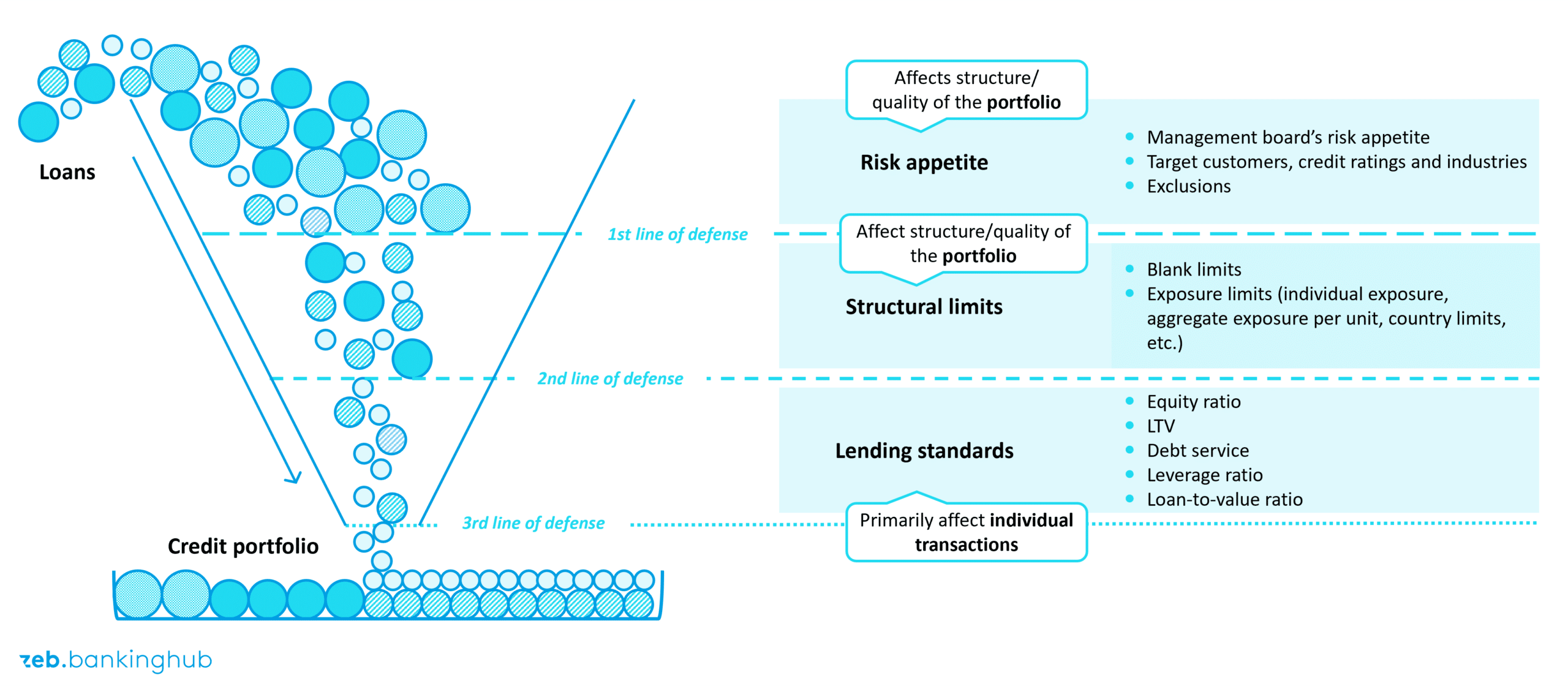
Especially from a management perspective, this close interplay is crucial. Lending standards transform the risk appetite into a sound basis for decision-making. They ensure that individual decisions do not undermine strategic objectives while showing where the institution is consciously taking risks.
How do lending standards prove effective in day-to-day banking?
The greatest challenge does not lie in the technical definition of lending standards, but in their consistent implementation. Standards only have a steering effect if they are embedded, accepted and applied in the lending process. In practice, this means that lending standards must be an integral part of the lending decision and ongoing monitoring. Methodological responsibility often lies with the back office, in close coordination with controlling and bank management. The units that are directly involved in the credit decision apply the standards in operations.
Structured instruments have proven their worth for implementation. Traffic light systems allow for a differentiated assessment of individual credit parameters. While a “green” rating enables standard lending, “yellow” requires in-depth review and documentation. “Red” indicates either a rejection or the need for deliberate escalation to higher decision-making levels.
Deviations from lending standards do not signal a lack of management. On the contrary, they are permissible and often necessary in practice. What is important is that deviations are
- clearly marked as an exception,
- justified and documented comprehensibly,
- reported and analyzed transparently.
For executives, deviations provide valuable information for steering. If they accumulate in certain segments or parameters, this indicates the need to critically review the standards or the underlying risk strategy
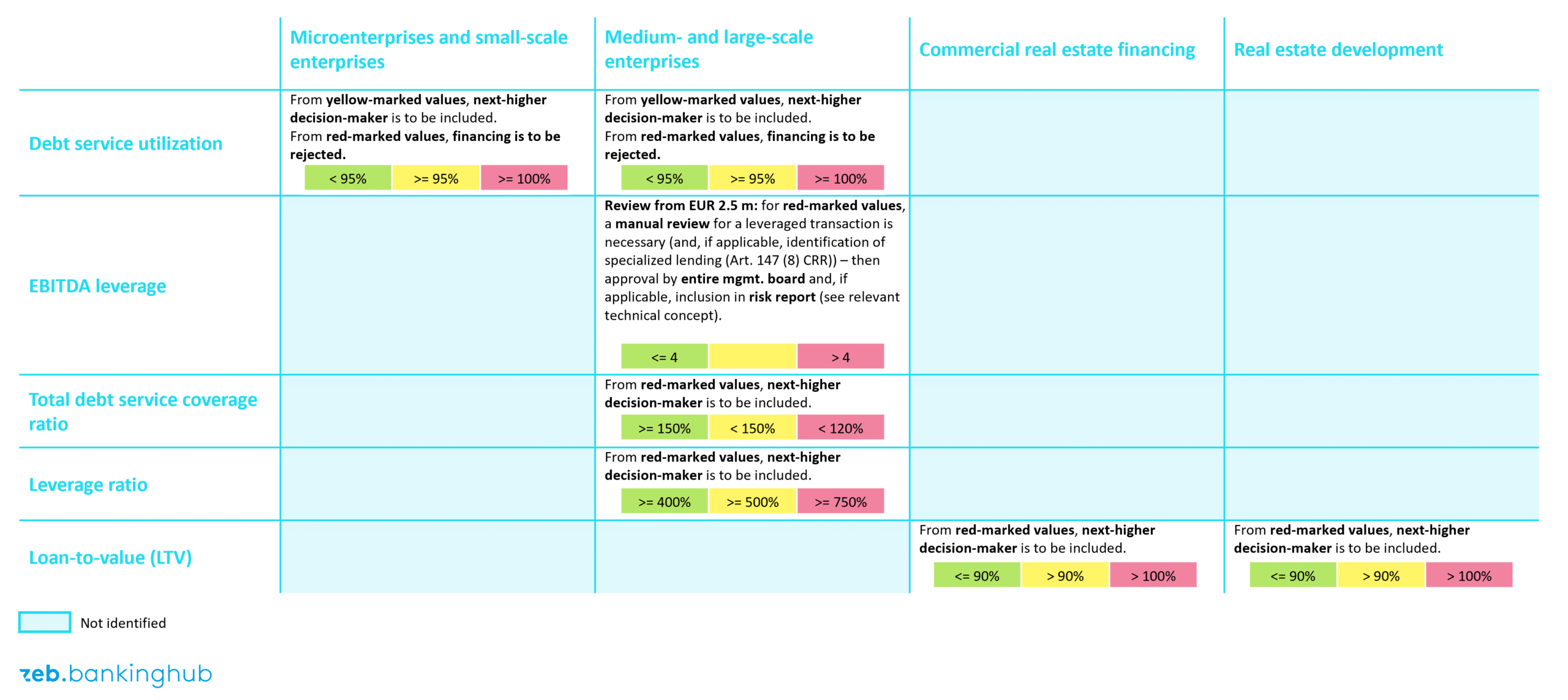
How can lending standards be designed to comply with regulatory and risk requirements?
Institutions take different approaches to developing their lending standards. Some use regulatory requirements as firm guidance, in particular the EBA guidelines. This approach ensures that regulatory expectations are fully met. Other institutions choose a more risk-oriented approach. They analyze the main risk drivers for each customer segment and business model and translate them into suitable credit parameters. Both approaches are legitimate. What is decisive is that the lending standards are consistent with the risk strategy and do not contradict it.
Regardless of the selected approach, lending standards must be regularly reviewed and validated. Changes in the economic environment, new findings from nonperforming loans or strategic realignments call for adjustments. An annual review has become established as the minimum standard.
Which five success factors determine whether lending standards prove effective in practice?
Lending standards must meet certain qualitative prerequisites if they are to comply with regulatory requirements and also take effect in day-to-day business:
- Clear threshold values: Defined threshold values enable a differentiated assessment and consistent traffic light logic. They indicate where a standard decision is possible and where additional checks are required.
- Permanence: Lending standards apply throughout the entire credit life cycle. They are not limited to new business decisions but are also relevant for ongoing monitoring.
- Segment specificity: Different customer segments require different standards. Consumers, medium-sized companies and property developers each have their own risk profiles. Customized segmentation increases acceptance and effectiveness.
- Exact business model fit: The selected parameters should take into account both past and future-oriented indicators and match the institution’s complexity. Less is often more: the decisive factor is relevance, not the number of key figures.
- Differentiation: Every lending standard must be clearly defined and pursue a distinct objective. Overlaps and vague delineations complicate application and weaken the steering effect.
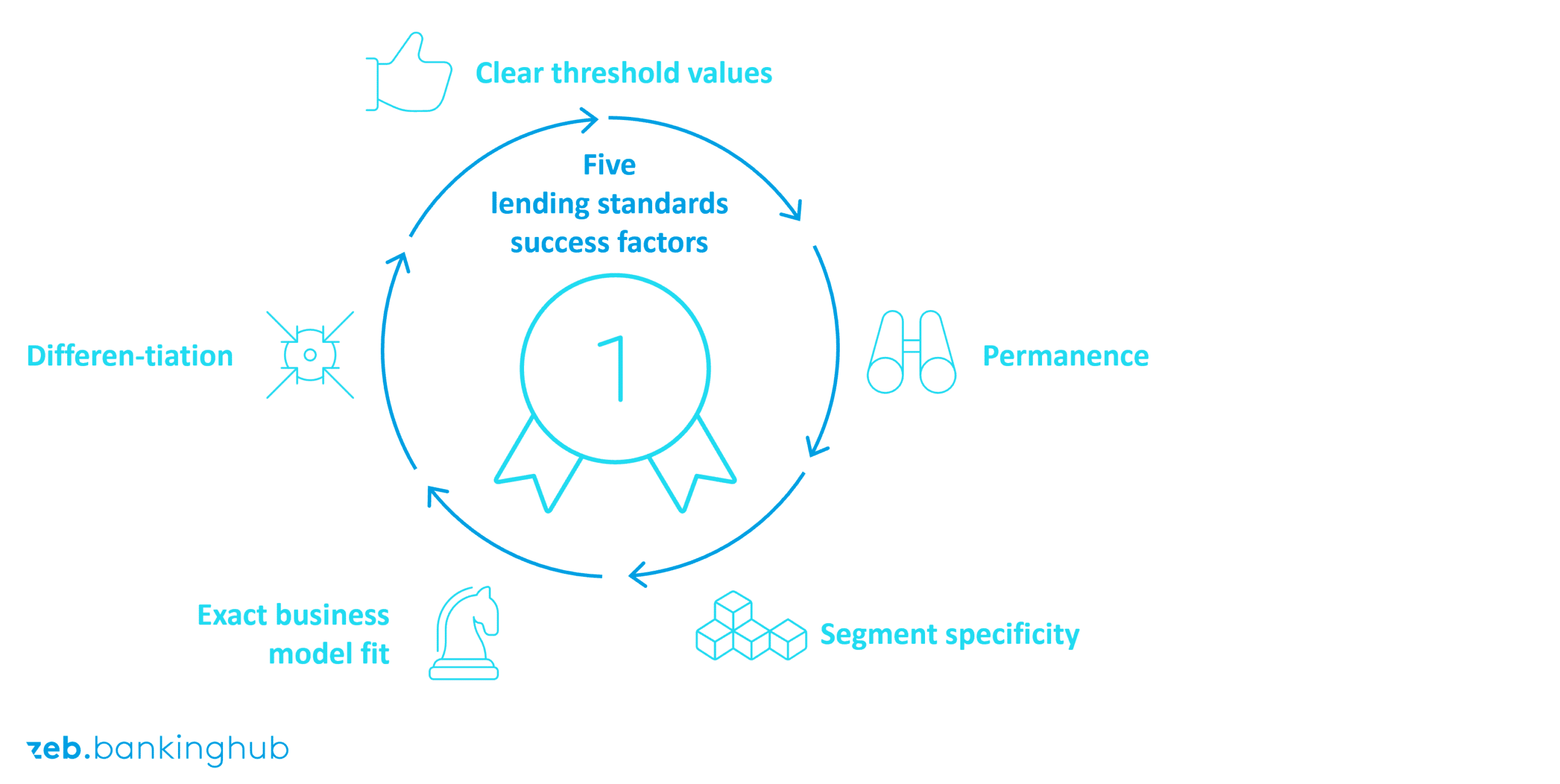
If banks take these criteria into account, they can achieve consistently and practically designed lending standards.
Conclusion: how can lending standards be used as a management tool?
Lending standards are far more than a regulatory chore. They are a key instrument for dovetailing risk appetite, portfolio structure and operational credit decisions. Particularly in the current environment of increasing uncertainty, they determine whether institutions consciously steer their risks or merely administer them.
For management teams, this means that lending standards should not be viewed in isolation, but should be seen as an integral part of integrated performance and risk management. Their effectiveness depends less on their formal design than on their consistent application, regular review and clear integration into strategy and processes.
Institutions that use lending standards strategically create transparency, increase the quality of their lending decisions and strengthen the long-term stability of their credit portfolio – and thus their own future viability.