Is there a clear price for tangible performance?
Direct banks and neobanks rely on a streamlined offering at low prices, meeting their customers’ expectations. After all, those who pay less tend to expect less. Regional banks, by contrast, stand for proximity, diversity and quality – with a corresponding price point.
At the same time, branches and service hours have been reduced over the years, self-service options have expanded, and offerings standardized. From a business perspective, this may seem reasonable at first. But when there’s a mismatch between customer expectations and perceived value, dissatisfaction follows.
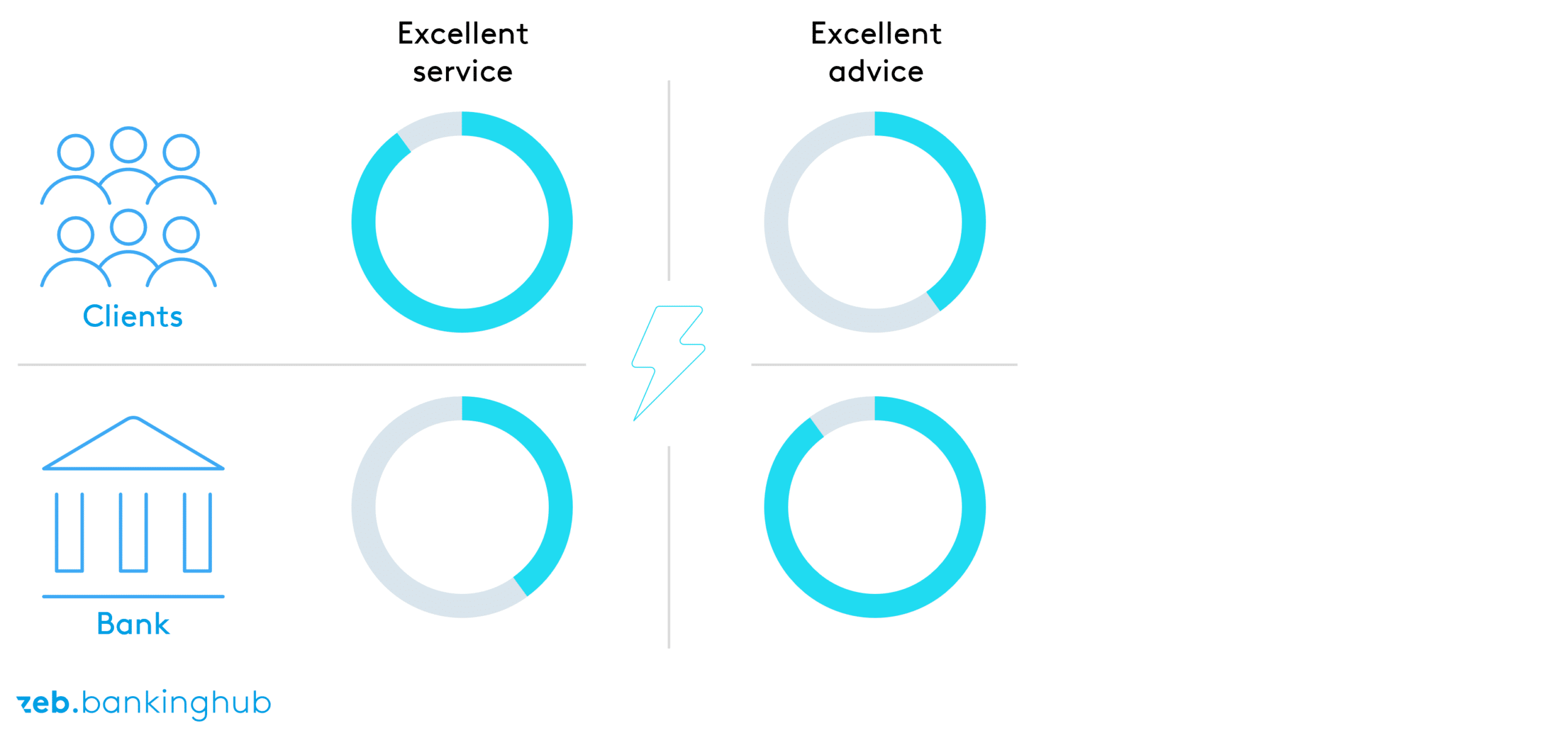
Those who pay for “premium” expect a “premium experience”. To justify their premium pricing going forward, regional banks must not only offer excellent service and advice – they must make it consistently tangible for their customers. So why hasn’t that worked so far?
Why do customers think in experiences, not channels?
Customer expectations for service and advice have changed dramatically. They are shaped by everyday experiences:
- In supermarkets, self-scanning makes their checkout process quicker and more independent.
- Streaming platforms suggest content before you even start searching.
- Furniture stores offer video consultations with integrated 3D room planners.
These and many other new conveniences are now being transposed into banking. Why print forms to open an account – when elsewhere you can authenticate with Face ID? Why wait days for a credit decision – when other industries respond in seconds?
The question is no longer whether banks need to adapt to these developments, but how quickly and consistently they do so. It’s not about choosing between “digital” and “personal”. It’s about combining both – intelligently and seamlessly. Failing to meet customer expectations means risking that they’ll look elsewhere – and in today’s digital world, alternatives are more abundant than ever.
What will the regional bank of tomorrow look like: personal, digital, connected?
Regional banks are ideally positioned to create a compelling overall experience by combining digital processes with personal proximity. As full-service providers with both a local presence and digital offerings, they can excel across channels – if they leverage this strength.
Customers today expect not only a broad range of services, but also seamless integration and high quality across all touchpoints: For example, financial products should be accessible with just a few clicks, loan applications reviewed within minutes and issues resolved quickly via self-service – without long waits or cumbersome document requests.
An account opening process that drags on for days no longer feels up to date in an era of digital onboarding. Even identification requirements are no longer accepted by customers as an excuse for clunky processes – it’s up to the banks to find smart solutions to these challenges.
Why is customer service not a cost center but a driver of trust?
In practice, the focus often lies on advisory services, yet regional banks typically reach “only” 30 to 40% of their customers this way. In reality, 75% of all customer touchpoints are service-related – but in many banks, they’re treated as a mere obligation.
The principle is clear: reliable, high-quality service builds trust – and opens the door to meaningful advisory conversations. Those who excel here not only enhance their customers’ experience but also lay the foundation for sales success.
What role does channel integration play?
Today’s customers expect consistent quality and services across every channel – app, phone, branch. To generate trust, all touchpoints need to work together seamlessly. What it takes:
- Clear synchronization of service offerings across channels and devices
- Standardized, multilingual service options
- Simple, intuitive-to-use technologies at the branch – as a supplementary offering, not as a replacement
- Smart guidance toward self-service options – without pressure
- A focus on the customer’s concern, not their segment – enabling faster solutions and greater closeness
Banks should aim to free service staff from routine inquiries – and empower them to spark genuine enthusiasm in every personal interaction.
How should advisory services be delivered: personalized, proactive, data-driven?
Advisory services also need an update – away from standardized approaches and toward true personalization. Customers no longer expect generic campaigns like “building society savings weeks,” but tailored solutions delivered at the right time. This also helps regional banks avoid direct competition with providers that dominate specific product niches.
Outstanding advisory services are not just reactive – they proactively create value and are supported by modern digital tools. In this context, regional banks would benefit from enhancing the quality of their customer data.
Today, data reveals so much about customer needs that banks can become true solution partners across the entire financial value chain – if they systematically collect, maintain and analyze it. Personal conversations between advisors and customers also offer valuable insights that can be fed into structured data systems. Altogether, this empowers the institutions to engage customers in a targeted and proactive manner. It also allows them to stand out positively from digital competitors.
Excellent advisory services also mean keeping a close eye on customers’ specific needs at each stage of life – and proactively offering relevant solutions as the primary bank, before customers turn to comparison or brokerage platforms in search of the lowest price.
Must customer satisfaction be measured?
To remain successful in the long term, regional banks must consistently track their customers’ satisfaction and continuously adapt in response to the insights gained. A static approach is no longer sufficient – banks must operate as learning organizations that evolve continuously.
To do so, each regional bank should establish a clear sales strategy and optimize its sales processes with seamless handovers between channels. Only then can advisory services and customer support not only be delivered with excellence but also experienced in a way that inspires customers to actively recommend their bank.
Conclusion: what is the biggest challenge in customer service?
Regional banks face the challenge of combining their strengths in personal interaction with the demands of a digital world. Those who treat customer service as a strategic success factor, personalize advisory services consistently and integrate channels intelligently can position themselves as their customers’ preferred partner – sustainably and with lasting impact.

More insights into retail banking at regional banks
If you’re interested in gaining further exciting insights into retail banking at regional banks, you can download the latest whitepaper “Omnichannel: Excellence in customer and advisory services – How regional banks can hold their own against (digital) competitors in the retail banking business.” here.