This image was generated using artificial intelligence (AI).

Home » Topics

Ambidexterity: successfully managing contradictions

This image was generated using artificial intelligence (AI).
Ambidexterity, originally derived from Latin, denotes the ability to use both the right and left hand equally well. In an organizational context, it describes an organization’s capacity to address two seemingly contradictory challenges simultaneously. A classic example of ambidexterity is efficiently managing operations while fostering innovation and creative processes.

Key aspects of ambidexterity

By embracing ambidexterity, companies can optimize their existing business processes while concurrently developing new, forward-looking ones.

  • optimizing and enhancing the efficiency of existing processes, products and services.
  • seeking and implementing new ideas, innovations and technologies.
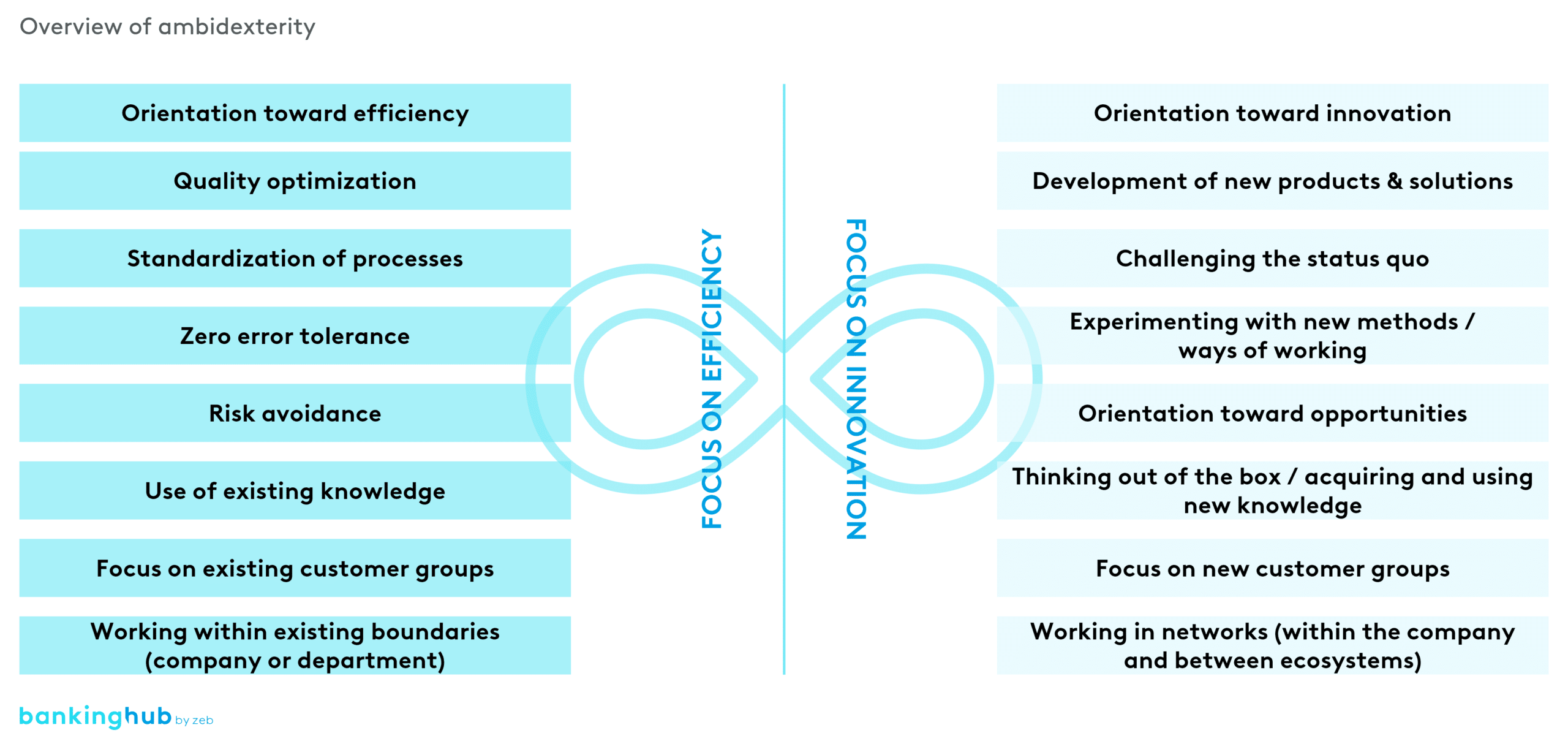
Combining efficiency and innovation through ambidexterity Figure 1: Combining efficiency and innovation through ambidexterity

The relevance of ambidexterity in today’s banking and insurance world

In today’s dynamic financial landscape, ambidexterity – the organization’s ability to be both efficient and innovative at the same time – is paramount for banks and insurance companies. The advancement of digitalization, coupled with evolving regulatory requirements and mounting pressure from fintech and insurtech companies, compels established financial institutions to simultaneously optimize their traditional business models and develop new, forward-looking approaches.

Within the banking sector, this means maintaining efficient and reliable processes in traditional banking operations such as lending and risk management while concurrently developing and implementing new, innovative digital business models and technologies.

… and this relevance continues to grow

  • Technological innovation: New technologies, such as artificial intelligence, blockchain and big data, are fundamentally reshaping the financial landscape. Financial institutions must strike a balance between maintaining the efficiency of their traditional systems and strategically investing in these emerging technologies.
  • Changing customer demands: Customers increasingly demand digital, rapid and personalized services. Ambidexterity allows financial institutions to enhance existing services while simultaneously developing innovative offerings.
  • Regulatory requirements: The financial industry operates within a highly regulated environment. Ambidexterity enables institutions to efficiently meet existing compliance requirements while remaining adaptable to new regulatory changes.
  • Competitive pressure: Intense competition from fintech and insurtech companies is forcing traditional banks and insurers to constantly innovate to remain competitive.

Strategic facets of ambidexterity

Implementing ambidexterity in banks and insurance companies requires thoughtful strategic planning and execution. It is not only an operational challenge. It is a strategic necessity.

  • Dual business models: Companies need to invest in their traditional business models while also developing new, innovative business areas. This requires a clear separation of the two approaches, but also their integration.
  • Flexible leadership: Ambidexterity demands a new type of leadership – one that fosters stability in processes while encouraging creative innovation. Executives need to be flexible and adaptable to effectively manage both realms.
  • Resource management: Resources must be allocated in a binding manner in order to support the efficiency of existing processes and core business while also nurturing new ideas. This may involve creating dedicated budgets for innovation.
  • Cultural change: The corporate culture must evolve to foster openness to change and a willingness to innovate. Targeted change management programs can facilitate this cultural shift.

Barriers to implementing ambidexterity

The implementation of ambidexterity in banks and insurance companies is associated with considerable challenges. These can be both structural and cultural.

  • Organizational inertia: Traditional banks and insurance companies often operate within rigid structures and processes, hindering change and adaptability.
  • Cultural barriers: A risk-averse culture that prioritizes stability may impede innovation and flexibility.
  • Resource conflicts: Allocating resources between existing and new business areas may lead to internal conflicts.
  • Management complexity: Effectively managing efficiency-oriented and innovation-driven activities simultaneously demands specialized management skills and leadership approaches.

Checklist: Recommendations for implementation in practice

Successful implementation of ambidexterity in banks and insurance companies requires strategic and operational measures. The following are recommended for implementation:

Establish dual structures

Separate the units for traditional business and innovation to create an environment conducive to both areas. Cultivate specific cultural characteristics within each unit. For instance, maintain a zero error tolerance in efficiency areas and foster an open culture and the courage to make mistakes in innovation areas. Different incentives and objectives support this dual structure.

At the same time, executives with an eye out for efficiency and innovation are needed, regardless of the unit in which they work. This is because a complete separation ultimately leads to silo thinking rather than a dual, synchronized system.

Clear objectives are crucial for formulating expectations related to products, processes and other aspects. The path to achieving these objectives should also be described, whether it involves an expected level of detail, control loops, high implementation speed, or the development of new, innovative products with a pilot character. By adopting this approach, both perspectives can be integrated at a higher level. A leaning toward either efficiency or innovation can streamline work processes and provide clearer guidance for teams and employees.
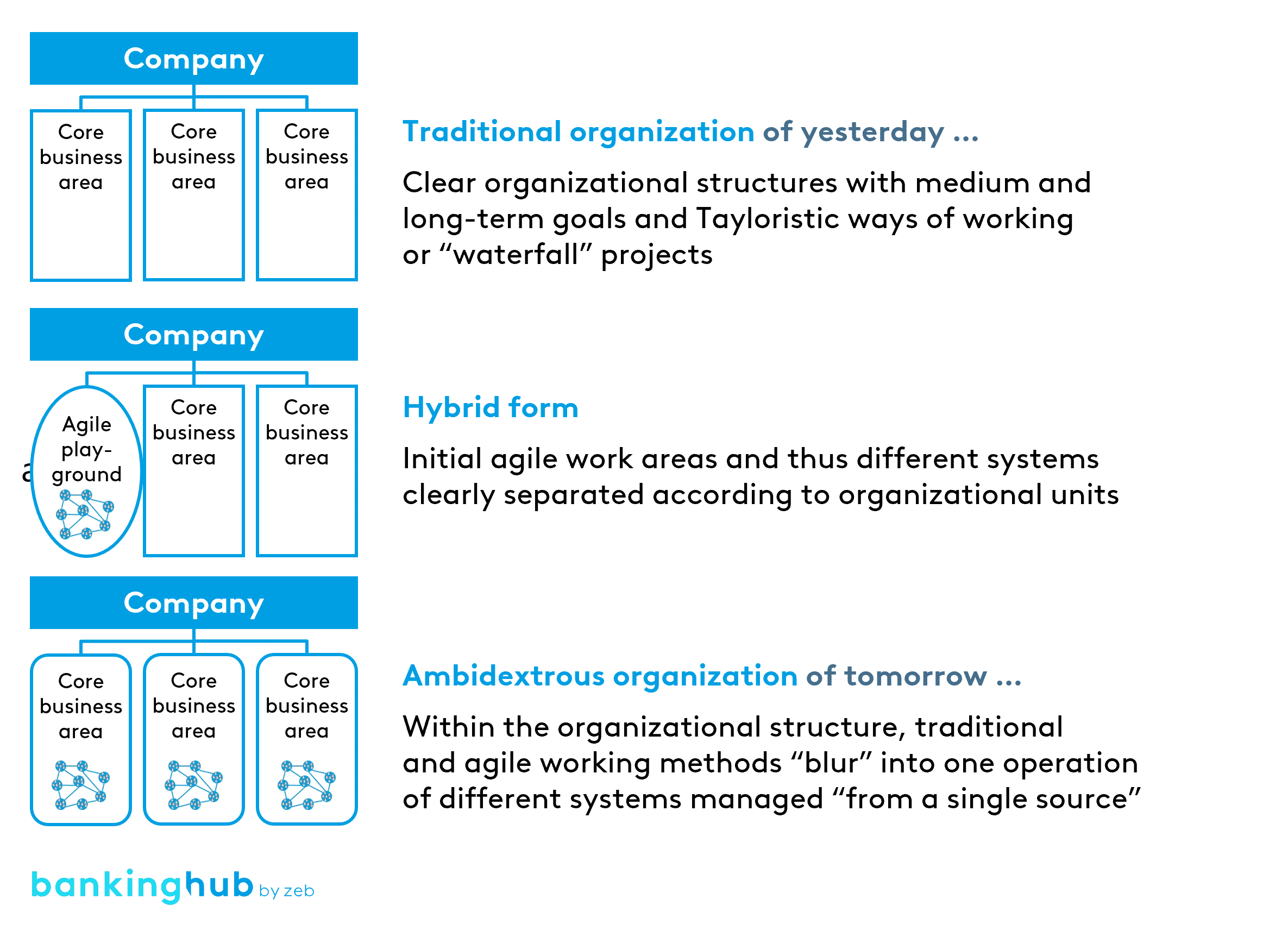
Using ambidexterity to combine innovative and “traditional” ways of working in the core business" Figure 2: Using ambidexterity to combine innovative and “traditional” ways of working in the core business

Encourage flexible leadership

Training and development programs for executives should aim to support both efficiency and innovation, providing the ability to recognize when either creativity-promoting leadership or tighter control is required. However, both approaches should be part of executives’ toolbox.

Utilize breathing target systems and HR tools

Strategic and operational goals require vigilant monitoring and timely adjustments. This principle applies equally to efficiency and innovation areas. By adapting to dynamic changes during the year, new targets can be set at short notice.

Furthermore, strategies should undergo frequent review and adjustment in short cycles. In today’s dynamic landscape, it is not uncommon for new trends to emerge in the short term, prompting a reprioritization of topics and projects within long-term planning.

Implement incubation programs

Establish innovation centers or incubators to develop and test new ideas in a controlled environment. Consider applying similar principles to efficiency-oriented areas, too.

Adopt agile methods

Utilize agile project management techniques to enhance flexibility and promote rapid adaptability.

  • Encourage continuous learning: Foster a culture of ongoing learning and training to keep employees informed about the latest technology trends and market needs. Recognize that learning also means unlearning!
  • Adapt error cultures: Ambidexterity explains the error cultures of both worlds. In efficiency areas, a zero error tolerance prevails, and teams and employees are expected to work with meticulous attention to detail. Innovation areas, however, require the courage to make mistakes, to experiment and occasionally step outside with half-baked solutions.
  • Allow pilot projects and experiments in innovation areas: Encourage pilot projects and experiments to test innovative ideas in a controlled environment. This allows for making mistakes and learning from them without putting the entire organization at risk.
  • Embrace continuous improvement: Establish a process for continuous improvement that encompasses both operational efficiency and innovation. Bear in mind that reviewing and adjusting the strategy on a regular basis is essential.

Conclusion on implementation in banks and insurance companies

Ambidexterity plays a pivotal role for banks and insurance companies in today’s dynamic financial landscape. It empowers them to simultaneously uphold the efficiency of existing business processes while forging new, innovative approaches. Despite the challenges inherent in implementation, long-term competitive advantages can be achieved through targeted measures and a keen focus on key success factors.

A clear vision, top management support, cultural transformation and effective change management are essential to successfully integrate ambidexterity and ensure future-viability.


Feel free to contact us!

Christina Block / Autorin BankingHub

Dr. Christina Block

Senior Manager at zeb Office Berlin

Articles on the topic

Lobby of a modern bank branch

How can the branch be protected as a unique selling point of regional banks?

Regional banks with about 13,000 branches remain the last anchor for customers to experience banking locally. They should therefore start to view their branch network not as a burden, but as an opportunity to stand out against their competitors in the long term. Personal contact and individual advice at branches will remain central to serving bank customers for at least another 20 years.

Weiterlesen »
A young customer gazes thoughtfully into the future as a metaphor on how regional banks can retain young customers?

How can regional banks retain young customers?

Roughly 15% of Germany’s population – over 12 million individuals – falls within the 14 to 27 age group. Why are young customers digitally savvy, but financially overwhelmed? In view of the migration of young customers, how is the role of the primary bank changing?

Weiterlesen »
A woman using a smartphone as a symbol of the strengthening of banks' digital sales channels

How can banks strengthen their digital sales channels?

In a world where, on average, people check their smartphones every twelve minutes, banks can no longer afford to ignore mobile-first offerings. Many regional banks responded early and now offer technically sophisticated online banking systems and powerful apps.

App usage is high – and in purely quantitative terms, digital log-ins have even increased customer contact. Yet it is clear that sales success through digital channels is still falling short of its potential.

Weiterlesen »
zeb.market.flash 56

The stock rally continues, but the problems remain

zeb.market.flash #56, Q2 2026: Despite geopolitical tensions and a gloomy economic outlook, the stock markets rebounded significantly in the second quarter of 2026. At the same time, the world’s top banks are demonstrating solid financial performance and increased profitability in a market environment that remains volatile.

Weiterlesen »
clock as a metaphor for how should regional banks conceive working time in order to combine flexibility and productivity?

How should regional banks conceive working time in order to combine flexibility and productivity?

Working time has become a decisive competitive factor for success. If you want to attract talent, retain top performers and work efficiently at the same time, you need a systematic working time concept. In practice, the focus is often too strongly on rigid case-by-case solutions. Instead, companies need guidelines that combine customer benefits, employees’ needs and profitability.

Weiterlesen »
Image of real estate in abstract terms, focusing on climate efficiency.

Energy performance certificates in real estate financing – generating sales potential from regulatory obligations!

Energy efficiency and sustainability have become key issues in almost all branches of economic activity in recent years. Both topics are also gaining in importance in the area of real estate financing, particularly with regard to legal requirements and the handling of energy performance certificates.

This raises complex questions for banks and, above all, their managers: How can the requirements be met efficiently, what challenges need to be overcome and what (sales) opportunities does a proactive approach to energy performance certificates offer?

Weiterlesen »
zeb.market.flash #54

Banks crown successful year with Q4 rally

zeb.market.flash #54, Q4 2025: The global capital markets ended Q4 2025 with moderate gains (MSCI World market cap. +3.2% QoQ). Despite pronounced uncertainty factors – including the longest government shutdown in US history and poor consumer sentiment in Europe and the US – the markets proved resilient.

Weiterlesen »
notebook wiht data as a metaphor for asset tokenization – are we on the verge of a breakthrough?

Asset tokenization – are we on the verge of a breakthrough?

After an initial hype of asset tokenization, the topic went somewhat quiet among the general public. Now the projects initiated by many banks and the numerous press releases on transactions with tokenized securities show that the momentum is picking up again. So we are asking ourselves: are we on the verge of a real breakthrough?

Weiterlesen »
Sailing boat on a rough sea as a metaphor for when the wind changes: Private Banking Study Germany 2024:

Private Banking Study Germany 2024: When the wind shifts again

Sunny times in private banking? For years, private banking and wealth management have been the only segments in the private customer market to record significant growth. According to our calculations, this trend will continue with a growth rate of 5–7% at least until 2028. In the Private Banking Study Germany 2024, we have comprehensively analyzed the German private banking market .

Weiterlesen »
AI

SXSW 2025: from FOMO to FOMA

The progress and impact of artificial intelligence were the key topics of this year’s SXSW Conference, which ended last weekend in Austin, Texas. Discussions at the conference revolved around technological aspects such as robotics and the integration of AI into biotechnology, as well as the economic and social implications of AI, including the concentration of power and growing inequality.

Weiterlesen »
Christmas tree as a metaphor for the BankingHub annual review / christmas article

A look back at the banking industry’s year 2024

With more than 1,800 articles published over the past decade, we have become a pivotal news platform and the go-to source for experts and people interested in banking. THANK YOU, dear readers, (guest) authors and experts: your trust has driven us forward and made us what we are today.

Weiterlesen »
Data lightbulb as a metaphor for ESG and Austrian banks - the pressure is on

ESG and Austrians banks – the pressure is rising

Austria’s regional banks are facing the challenge of asserting themselves in a changing market environment. This can, however, also be an opportunity. The integration of ESG criteria offers banks a unique chance not only to transform their business models, but to tap into new sources of income.


Weiterlesen »
Young woman looking at an abstract data screen as metaphor for wealth management and the new generation’s securities business

Wealth management and the new generation’s securities business

What’s special about the investment behavior among Gen Z? Which success factors should wealth managers consider in this context? In this interview, Mr. Thienel, Director Product Core Banking, Universal Banking, at Finastra, answers these and many more questions about wealth management and the securities business of the new generation.

Weiterlesen »
Skyscraper in construciton with green plants bottom-up as metaphor for the ESG Study 2024: Europe’s banks under the microscope

ESG Study 2024: Europe’s banks under the microscope

In cooperation with the Liechtenstein Bankers Association, zeb asked 36 European financial institutions, including large, state/cantonal and domestic-oriented banks, to self-assess their ESG status quo. The outlook for the institutions surveyed is sobering: the majority still face significant challenges on their path to sustainable transformation.

Weiterlesen »
skyscrapers overgrown with green trees as metaphor for the ESG transformation advancing

ESG transformation advancing but still in progress

Every quarter, zeb.market.flash provides an overview of the performance of the world’s largest banks (measured by market capitalisation). This issue (#49 – July 2024) deals in detail with our special topic “ESG transformation advancing but still in progress”.

Weiterlesen »
interest rate risk conundrum

The interest rate risk conundrum

What is behind the alleged discrepancy between the banks’ negative IRRBB exposures and the observed increase in profitability? Which hedging strategies should banks use in the changed environment?

Weiterlesen »
Start into a potentially challenging year 2024f or banks

A splendid start into a potentially challenging year

Every quarter, zeb.market.flash provides an overview of the performance of the world’s largest banks (measured by market capitalisation). This issue (#48 – April 2024) deals in detail with our special topic “CRE in turmoil and vulnerability of Western European banks”.

Weiterlesen »
Daniel Valenzuela, Head of Impact at World Fund

Impact investing: World Fund interview

We had the opportunity to discuss the topic of impact investing with Daniel Valenzuela, Head of Impact at World Fund, a venture capital company that was founded in 2021 and specializes in funding climate tech start-ups.

Weiterlesen »
Abstract space concept image as metaphor for electronic securities and the choice of register solution

Electronic securities and the choice of register solution

How is the market for electronic securities and technical solutions developing? Is scalability the main differentiator? In cooperation with tokenforge, we take a look at the current development of the market for electronic securities and technical solutions for maintaining a crypto securities register.

Weiterlesen »
Abstract cloud computing and network as metaphor for ECB guidelines on risk data aggregation

New ECB guidelines on risk data aggregation and risk reporting

Ever since the ECB’s announcement of its supervisory priorities for 2023–2025 in December 2022, followed by Andrea Enria’s keynote speech during the Annual Conference on Banking Supervision in March 2023, it has become clear that banks will have to revisit the compliance gaps in their risk data aggregation and risk reporting processes. Implications for G-SIBs and opportunities for smaller banks.

Weiterlesen »
Marina Fleischhauer and Daniel Werther

Construction financing: the path to success

In an interview with Marina Fleischhauer, head of the ecosystems department, and Daniel Werther, head of sales for construction financing at Volksbank Mittelhessen, we talked about opportunities for change, the transformation process “from construction financing specialist to home construction and improvement advisor”, and experiences gained to date.

Weiterlesen »
Cover whitepaper: Private Banking Study Germany 2022

Private Banking Study Germany 2022

The assets of German private banking customers are growing steadily: in 2022, they already amounted to EUR 7.2 trillion and are expected to increase to EUR 10.3 trillion by 2027. In our Private Banking Study Germany 2022, we have comprehensively analyzed the German private banking market. In this article, we provide an insight into the results.

Weiterlesen »

Crypto crisis: the end of Bitcoin and other cryptocurrencies or a wake-up call for stronger regulation?

The crypto debate: Is the crypto crisis the end of Bitcoin & other cryptocurrencies, or a call for stronger regulation? In this interview, Dr. Nils Bulling, Head of Strategic Innovation, Ecosystem & Digital Assets at Avaloq, shares his personal view on the current crisis in the crypto market and his predictions of how cryptocurrencies such as Bitcoin could develop in the future.

Weiterlesen »

Comments

Leave a Reply

Your email address will not be published. Required fields are marked *

BankingHub-Newsletter

Analyses, articles and interviews about trends & innovation in banking delivered right to your inbox every 2 weeks